Not many companies can make 150 years of trading but the Co-Operative Group was founded as the North of England Co-operative Wholesale Industrial and Provident Society Limited in Manchester in 1863. From 1872 it became the Co-Operative Wholesale Society (CWS), and after a merger with Co-Operative Retail Services in 2000 they chose the name Co-Operative Group.
Forward to the present day and an exhibition at the People's History Museum in Manchester on Saturday 12th October 2013 thru to Saturday 11th May 2014. Plenty of visiting days, it's free and there is a fine cafe too. More to follow....after the exhibition opens. Might as well join in by publishing some photos of CWS memorabilia like the 1940's packet of tea as seen above. That's a 4oz packet of loose tea before tea bags became the norm...more pictures to follow.
All the links you need:
The People’s Business – 150 Years of The Co-operative
Co-Op Events at the People's History Museum
Co-Operative Group at 150 years (pictures and timeline)
Situated in a suburb of Manchester, England this is a story of a co-op store still with meeting rooms above the shop, and the lane itself. Plus other related or not so related history.
Showing posts with label CWS. Show all posts
Thursday, October 3, 2013
Sunday, September 15, 2013
Longsight Printing Works
Reading through many old co-op society magazines and pamphlets the imprint "CWS Printing Works Longsight" is on the publication. I thought the old printing works had long since been demolished until I took a cycle short cut down Hamiliton Road in Longsight and caught glimpse of the building. It took a few more months before returning with a camera.
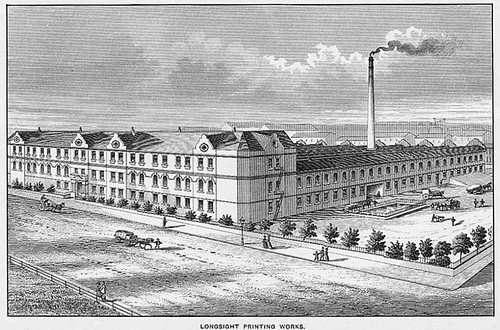
CWS Printing commenced in January 1895 off Balloon Street in Manchester, and such was the need for more output a site was acquired in Longsight and production commenced in July 1898. The works expanded over the years and employed 1,100 persons in 1913. Printing wasn't as mechanised as today so lots of hands, both men and women were needed to collate, trim, bind and box all that paper.
The attractive engraving shows a magnificent structure and with artistic licence the roads are shewn overly wide and spacious. Built on large open plot behind the shops on Stockport Road with Gore Brook and Rushford Farm to the right and east of this illustration. It has been knocked about since its heyday. The chimney and pond have gone, the brook is under a culvert but the original entrance to the offices on Hamilton Road survives.
The illustration is from The Story of the CWS: the jubilee history of the Co-Operative Wholesale Society by Percy Redfern (1913). You can download it at Archive.Org
CWS Printing commenced in January 1895 off Balloon Street in Manchester, and such was the need for more output a site was acquired in Longsight and production commenced in July 1898. The works expanded over the years and employed 1,100 persons in 1913. Printing wasn't as mechanised as today so lots of hands, both men and women were needed to collate, trim, bind and box all that paper.
The attractive engraving shows a magnificent structure and with artistic licence the roads are shewn overly wide and spacious. Built on large open plot behind the shops on Stockport Road with Gore Brook and Rushford Farm to the right and east of this illustration. It has been knocked about since its heyday. The chimney and pond have gone, the brook is under a culvert but the original entrance to the offices on Hamilton Road survives.
The illustration is from The Story of the CWS: the jubilee history of the Co-Operative Wholesale Society by Percy Redfern (1913). You can download it at Archive.Org
Saturday, March 23, 2013
Defiant Radio Story #1
The Rochdale Pioneers Museum is having a 'Defiant Radios Fun Day'.
That's Wednesday April 10th 2013 from 1100 - 1600h. A heady cocktail of
vintage radio and co-operative history. Steady.
The Defiant radio story is one of co-operatives set against price fixing by a cartel of electrical manufacturers. At the time the Co-op wanted to sell radio sets but they could not "discount" and the "divi" was a form of discount. So the solution was to find a subcontractor to make their own brand. Eventually a deal was struck with Plessey to make the radios, with Mazda valves the brand name of BTH (British Thompson-Houston, I think it was a subsidiary of AEI then) and the wooden cases to enclose the receiver were supplied by the CWS cabinet works. It's appropriate that they called their own brand of radio "Defiant".
The Resale Prices Act abolished price fixing in 1964. After that the retailer or chain store could decide their own price for goods . Ironically the end of retail price maintenance in Britain had a devastating affect on co-operative society sales especially food, and helped the rise of the multiples .
The Defiant wireless sets were on sale from 1933 with the MSH 901 manufactured by GEC but they joined the Radio Manufacturers Association embargo of dealing with the CWS hence a 1934 deal with Plessey. Later radiograms, gramophones, record players, transistor radios and a television in the 1950's were available. At least 85 different models were put on sale until 1967. All now collectors' items but affordable that is if you can obtain a working model. Why haven't I bought one?
Back in the 1930's a wireless would set you back two weeks average wages of work, there weren't many radio stations to tune into and you had to pay the annual licence fee of ten shillings (50p). But still a must have big ticket item of its day bringing music and talk into your home that we take for granted.
Pictures : Dial of the Defiant MSH902 from 1934; Defiant MSH914 from 1935-1938,
Link :Rochdale Pioneers Museum Defiant Radio Day
Links for more
The Defiant radio story is one of co-operatives set against price fixing by a cartel of electrical manufacturers. At the time the Co-op wanted to sell radio sets but they could not "discount" and the "divi" was a form of discount. So the solution was to find a subcontractor to make their own brand. Eventually a deal was struck with Plessey to make the radios, with Mazda valves the brand name of BTH (British Thompson-Houston, I think it was a subsidiary of AEI then) and the wooden cases to enclose the receiver were supplied by the CWS cabinet works. It's appropriate that they called their own brand of radio "Defiant".
The Resale Prices Act abolished price fixing in 1964. After that the retailer or chain store could decide their own price for goods . Ironically the end of retail price maintenance in Britain had a devastating affect on co-operative society sales especially food, and helped the rise of the multiples .
The Defiant wireless sets were on sale from 1933 with the MSH 901 manufactured by GEC but they joined the Radio Manufacturers Association embargo of dealing with the CWS hence a 1934 deal with Plessey. Later radiograms, gramophones, record players, transistor radios and a television in the 1950's were available. At least 85 different models were put on sale until 1967. All now collectors' items but affordable that is if you can obtain a working model. Why haven't I bought one?
Back in the 1930's a wireless would set you back two weeks average wages of work, there weren't many radio stations to tune into and you had to pay the annual licence fee of ten shillings (50p). But still a must have big ticket item of its day bringing music and talk into your home that we take for granted.
Pictures : Dial of the Defiant MSH902 from 1934; Defiant MSH914 from 1935-1938,
Link :Rochdale Pioneers Museum Defiant Radio Day
Links for more
Wednesday, March 20, 2013
New Co-Op Book in September 2013
The first major business history of the CWS/The Co-operative Group in over fifty years is coming out in hardback this autumn. The pre-ordering is taking place and the blurb describes what you get for thirty pounds. Yes it has pictures in it.
"Based on extensive archival research, many of the materials being made available to historians for the first time. Brings new attention to co-operatives as a distinctive business type from investor owned models. Published to coincide with the 150th anniversary of the Co-operative"
Profit with Principles? A Business History of The Co-operative Group, 1863-2013 by John F. Wilson, Anthony Webster, and Rachael Vorberg-Rugh; 464 pages | Numerous black and white illustrations; colour plate sections | 246x171mm 978-0-19-965511-3 | Hardback | September 2013 (estimated) Price: 30.00 GDP Oxford University Press
So something to look forward to then......
"Based on extensive archival research, many of the materials being made available to historians for the first time. Brings new attention to co-operatives as a distinctive business type from investor owned models. Published to coincide with the 150th anniversary of the Co-operative"
Profit with Principles? A Business History of The Co-operative Group, 1863-2013 by John F. Wilson, Anthony Webster, and Rachael Vorberg-Rugh; 464 pages | Numerous black and white illustrations; colour plate sections | 246x171mm 978-0-19-965511-3 | Hardback | September 2013 (estimated) Price: 30.00 GDP Oxford University Press
So something to look forward to then......
Sunday, October 7, 2012
Relics from the 1970's
Back to the 1970's. It's over 40 years ago, but sometimes when you listen to the radio it is like it never went away.
That old 45 rpm might have been digitized to mp3 so living on but other items from that era are now relics in cupboards.
The trading stamps in place of the dividend. If you asking are they worth anything? Only if someone wants to buy them, and in short no.
The little badges, about 3 cm in diameter were readily available for all sorts of advertising, propaganda and political campaigns from the 1960's onwards.
Not sure how many would have worn this old co-op badge. The cloverleaf design dates from 1968. The colour scheme doesn't make it the most attractive. It was probably given away free and some body's smart idea of low cost marketing. Again you may ask is it worth anything. Only if someone wants to buy them, and in short no.
Compare it to the iconic CND symbol available at the same time in badge form. One of the best known symbols and a design classic dating from 1958 by Gerald Holtom. It is still available to purchase.
If you have any of this ephemera don't throw it out. Fashions change, they don't make it anymore and values can go up.
Related post : Own Brand 1970's.
That old 45 rpm might have been digitized to mp3 so living on but other items from that era are now relics in cupboards.
The trading stamps in place of the dividend. If you asking are they worth anything? Only if someone wants to buy them, and in short no.
The little badges, about 3 cm in diameter were readily available for all sorts of advertising, propaganda and political campaigns from the 1960's onwards.
Not sure how many would have worn this old co-op badge. The cloverleaf design dates from 1968. The colour scheme doesn't make it the most attractive. It was probably given away free and some body's smart idea of low cost marketing. Again you may ask is it worth anything. Only if someone wants to buy them, and in short no.
Compare it to the iconic CND symbol available at the same time in badge form. One of the best known symbols and a design classic dating from 1958 by Gerald Holtom. It is still available to purchase.
If you have any of this ephemera don't throw it out. Fashions change, they don't make it anymore and values can go up.
Related post : Own Brand 1970's.
Monday, October 1, 2012
Pic-Nic 1934
There is something charming about the picnic. Been checking out what you would have had back in the 1920's and 1930's. The CWS advert here dates from 1934 and reads like a typical salad dinner you would eat in the summer months.
Not quite the Enid Blyton "Famous Five" (written between 1942 - 1962) who would have had lashings of hard boiled eggs, tomato sandwiches, lemonade, tinned sardines, melt-in-the-mouth shortbread, radishes, Nestlé milk, ginger beer, tins of pineapple chunks, squares of chocolate....
Modern times it could be olives, hummus, fresh peaches and chilled Prosecco from a cooler box. Your mileage may differ. Tupperware boxes of salad or those triangle sandwich packs sold at petrol stations. Maybe the invented traditional of the Ploughman's Lunch.
The advert has a quaint age of innocence. It is old style ready to eat food. If you wished to recreate a 1930's picnic using some of these products then it possible to find current brand equivalents. The fruit squash drink are not yet extinct. Spotted some of those meat paste items at the local co-op. Not a prominent item but still on the shelves. Tinned fruit is a relic when fresh strawberries, albeit not very tasty strawberries, are sold in January.
But the illustration makes it all look spiffing good fun. No wet grass then. Hey, ho we'll all off to scoff 'en plein air', and play some ball games or frisbie afterwards. That's the bit when people think it is pretty smart to do throw and catch.
But the romance of the picnic is still with us, even though the weather hasn't been clement this summer.
The photograph is a colour photograph of a picnic on Stanmore Common in London, taken by R E Owen, 20 May 1929. It's from the National Media Museum which is in Bradford...it looks just how a picnic should with the wicker basket, rugs on the ground and possibly proper glassware...
Further reading : A brief history of the picnic.
Not quite the Enid Blyton "Famous Five" (written between 1942 - 1962) who would have had lashings of hard boiled eggs, tomato sandwiches, lemonade, tinned sardines, melt-in-the-mouth shortbread, radishes, Nestlé milk, ginger beer, tins of pineapple chunks, squares of chocolate....
Modern times it could be olives, hummus, fresh peaches and chilled Prosecco from a cooler box. Your mileage may differ. Tupperware boxes of salad or those triangle sandwich packs sold at petrol stations. Maybe the invented traditional of the Ploughman's Lunch.The advert has a quaint age of innocence. It is old style ready to eat food. If you wished to recreate a 1930's picnic using some of these products then it possible to find current brand equivalents. The fruit squash drink are not yet extinct. Spotted some of those meat paste items at the local co-op. Not a prominent item but still on the shelves. Tinned fruit is a relic when fresh strawberries, albeit not very tasty strawberries, are sold in January.
But the illustration makes it all look spiffing good fun. No wet grass then. Hey, ho we'll all off to scoff 'en plein air', and play some ball games or frisbie afterwards. That's the bit when people think it is pretty smart to do throw and catch.
But the romance of the picnic is still with us, even though the weather hasn't been clement this summer.
The photograph is a colour photograph of a picnic on Stanmore Common in London, taken by R E Owen, 20 May 1929. It's from the National Media Museum which is in Bradford...it looks just how a picnic should with the wicker basket, rugs on the ground and possibly proper glassware...
Further reading : A brief history of the picnic.
Monday, September 24, 2012
John Shillito Medal
When the CWS celebrated its Golden Jubilee, that's 50 years from 1863 to 1913, it issued a medal which is featured here.
It's a relief portrait of John Shillito who was the President of the Co-operative Wholesale Society from 1895 to 1915. It was distributed to each delegate at the CWS shareholders’ meetings in 1913(there would be over 3,000 attending them) and to each of the 21,000 employees of the CWS. There was additional distribution to officials in the retail co-operative societies, so that the total number distributed in 1913 would be around 25,000. The medal is gold colour on bronze and weighs about 19 grams.
On the reverse side there is the logo of the CWS, a wheatsheaf flanked by a t-handle spade and a sickle. The motto is "Labor and Wait". Note the American spelling. There is a story about this logo and motto, and I need to find out more.
At the same time a large casket was issued which featured on it leading figures in the co-operative movement and illustrations of CWS premises. In the casket were samples of a range of CWS products.
John Sillito from Halifax, was then the grand old man of co-operation, he would be 81. When in his 70's he presided at the Co-op Congress at the Corn Exchange, Doncaster in 1903. He also entertained Captain Scott prior to his Antarctic Expedition. Born 19th January 1832. Died 12th February 1915 aged 83. Lived at 4 Park View, Hopwood Lane, Halifax in the year the medal was issued.
You can read about John Sillito's activities in "The Story of the CWS : Jubilee History 1913" it's at Archive.org - link.
It's a relief portrait of John Shillito who was the President of the Co-operative Wholesale Society from 1895 to 1915. It was distributed to each delegate at the CWS shareholders’ meetings in 1913(there would be over 3,000 attending them) and to each of the 21,000 employees of the CWS. There was additional distribution to officials in the retail co-operative societies, so that the total number distributed in 1913 would be around 25,000. The medal is gold colour on bronze and weighs about 19 grams.
On the reverse side there is the logo of the CWS, a wheatsheaf flanked by a t-handle spade and a sickle. The motto is "Labor and Wait". Note the American spelling. There is a story about this logo and motto, and I need to find out more.
At the same time a large casket was issued which featured on it leading figures in the co-operative movement and illustrations of CWS premises. In the casket were samples of a range of CWS products.
John Sillito from Halifax, was then the grand old man of co-operation, he would be 81. When in his 70's he presided at the Co-op Congress at the Corn Exchange, Doncaster in 1903. He also entertained Captain Scott prior to his Antarctic Expedition. Born 19th January 1832. Died 12th February 1915 aged 83. Lived at 4 Park View, Hopwood Lane, Halifax in the year the medal was issued.
You can read about John Sillito's activities in "The Story of the CWS : Jubilee History 1913" it's at Archive.org - link.
Sunday, August 19, 2012
CWS Puzzled
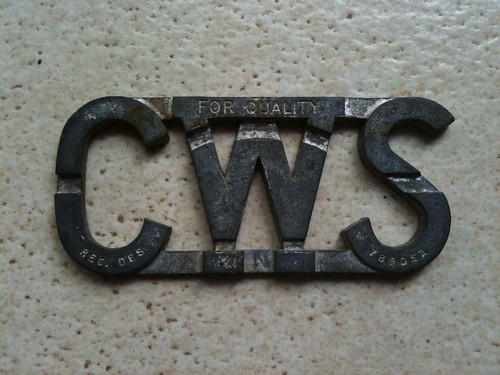
Picked this intriguing item the other day. Obviously the initials CWS (Co-operative Wholesale Society) took my interest. Approximately 7cm x 3cm x 0.4cm thick. It's metal, possibly steel and weighs 24 grams. Embossed into it are the words "For Quality", "Reg. Des", and "789052".
So what is it? Is it part of something larger? Puzzled, I soon found the answer. Registered Design 789052 is from 1934. It is part of a tanglement puzzle. You need at least two pieces in a puzzle and you have to separate them. It usually wastes a lot of your time to solve. Then you have to put it back together. Unfortunately the last time this puzzle was solved the other piece which was a tiny horseshoe got lost. It'll never be solved again. The chances of finding the other piece is a bit slim.
You can read all about Tanglement Puzzles, and see hundreds of photographs of them at Rob's Puzzle Page. In there is the puzzle itself, complete with the other part.
Wednesday, August 8, 2012
Factory in Lowestoft
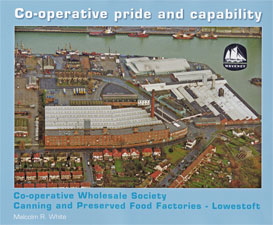
Had a 15 minute wait at the parcel office before I could collect my purchase. It's been around a few years and fortunately it is still in print. Wasn't disappointed. What are we writing about? A book called "Co-operative Pride and Capability
Co-operative Wholesale Society - Canning and Preserved Food Factories - Lowestoft".
Crisp colour plates, a short accurate history, interviews with those who worked there, lots of memorabilia and old advertisements. It is a niche history but it is put into context of the national picture of CWS factories. They were ultimately sold on to other companies. Who then closed them down and sold the land off.
Well might have gone to rubble but at least we have this treasure and it is the pictures that make it. Now when you see photographs from the different eras you can usually date them from the black and white tones, and the camera lens used as Edwardian or 1920's, 40's etc. Well you can if you've seen enough archive material. So the 1989 colour views looked dated as well. Those distinctive colours of the film shot on 35mm stock. A better expert than me could probably hazard a guess at which film was used to take the photographs. You can recreate them with digital images and some editing software. Well sort of but not quite.
So after a browse it now sits out on the table for visitors and myself to dip into nostalgia for the Waveney Brand of tinned goods that used to be available in co-operative stores.
All the details are here at Coastal Publications. I purchased it direct from them because it works out a little cheaper than from that well known online bookseller, plus they will keep a bigger share of the money. For we need people to keep publishing niche history, it makes some of us happy.
The East Anglia Film Archive have some short videos available online. It's In The Can made in 1961, colour with sound is a CWS Promotional Film for Waveney tinned foods. Co-Op and Labour Fete 1930, black and white, silent is some great amateur footage captured in Ipswich.
Crisp colour plates, a short accurate history, interviews with those who worked there, lots of memorabilia and old advertisements. It is a niche history but it is put into context of the national picture of CWS factories. They were ultimately sold on to other companies. Who then closed them down and sold the land off.
Well might have gone to rubble but at least we have this treasure and it is the pictures that make it. Now when you see photographs from the different eras you can usually date them from the black and white tones, and the camera lens used as Edwardian or 1920's, 40's etc. Well you can if you've seen enough archive material. So the 1989 colour views looked dated as well. Those distinctive colours of the film shot on 35mm stock. A better expert than me could probably hazard a guess at which film was used to take the photographs. You can recreate them with digital images and some editing software. Well sort of but not quite.
So after a browse it now sits out on the table for visitors and myself to dip into nostalgia for the Waveney Brand of tinned goods that used to be available in co-operative stores.
All the details are here at Coastal Publications. I purchased it direct from them because it works out a little cheaper than from that well known online bookseller, plus they will keep a bigger share of the money. For we need people to keep publishing niche history, it makes some of us happy.
The East Anglia Film Archive have some short videos available online. It's In The Can made in 1961, colour with sound is a CWS Promotional Film for Waveney tinned foods. Co-Op and Labour Fete 1930, black and white, silent is some great amateur footage captured in Ipswich.
Saturday, August 4, 2012
New Tea Warehouse
Follwing on from yesterday's post Teas of Empire II..... Tea was a joint venture by both wholesale societies. The adverts often used a heralding trumpet figure who wears an outfit just stepped out from an Alice in Wonderland story. Better pictures reveal that he has the wheatsheaf symbol on that quartered costume. I bet the image on the dark quarters is the logo of the Scottish CWS.
There is a certain irony in that there is also an illustration of the Cutty Sark. The famous tea clipper, though she spent more years carrying wool from Australia to Britain, has defied all odds and is preserved, and restored after the fire of 2007. It's at Greenwich in London. In 1930 she was anchored in Falmouth harbour having retired from sailing. However the massive tea warehouse in Salford mentioned in the text has not been preserved....it was demolished some years back. As for the SS Makalla she's gone too.
The SS Makalla, 6,677 tons, was built in Port Glasgow in 1918 and sunk in the Moray Firth by German aircraft in August 1940. She was sailing in convoy. Part of the Anchor Brocklebank Line she made regular trips to India and back to North West England ports loaded with tea. Besides cargoes for the E&CWS she carried tea for the rival and well known Mazawatti Tea Company. I love that name Mazawatti. Pioneers in advertising, they refused to sell tea to multiples and co-op societies and only traded with independent grocers.
Friday, August 3, 2012
Teas of Empire II
There used to be a massive tea warehouse on the Salford side of the Ship Canal. It was opposite the Pomona Docks, the original small docks at the start of the canal. I've never been sure at what point the canal starts and the River Irwell ends.
The most striking aspect of the building was the huge neon sign of a big teapot being filled with tea leaves by a lady standing on a tall stool. The bright light of the wording said the slogan "Filling the Nation's Teapot". Well this is how I remember it in a strong red colour. Now demolished. Still trying to find a good photograph of the building.
This display advert is from 1930 and like most of that time used line drawings.
Note it is only tea from the English & Scottish CWS plantations in India and Ceylon (Sri Lanka). It is loose leaf tea in 4 oz (about 113 gms) packets.
Seventy odd years later we can buy Fairtrade tea, most is consumed by using tea bags, and it comes from plantations not owned by The Co-Operative being blends from East Africa, India and Sri Lanka.
The most striking aspect of the building was the huge neon sign of a big teapot being filled with tea leaves by a lady standing on a tall stool. The bright light of the wording said the slogan "Filling the Nation's Teapot". Well this is how I remember it in a strong red colour. Now demolished. Still trying to find a good photograph of the building.
This display advert is from 1930 and like most of that time used line drawings.
Note it is only tea from the English & Scottish CWS plantations in India and Ceylon (Sri Lanka). It is loose leaf tea in 4 oz (about 113 gms) packets.
Seventy odd years later we can buy Fairtrade tea, most is consumed by using tea bags, and it comes from plantations not owned by The Co-Operative being blends from East Africa, India and Sri Lanka.
Thursday, July 26, 2012
Afternoon Film Show
Made it to the pleasant Wednesday afternoon talk about films made by co-operatives. It was at the Working Class Movement Library on a sunny day in Salford. We got to see some video to illustrate the talk. The picture in this post is a screen capture of Stanley Holloway who featured in a comedic role in one of the movies for the CWS.
Now I had seen most of the material before but not for years. There is something in the phrase "you see what you know". In two of the clips I spotted two CWS soap powders Spel and Paddy. A few months ago I wouldn't have noticed them but having written a couple of posts about them, and since they had more hits than usual the images stuck in my mind. I ask you - boxes of long defunct soap powders?
To be brutal this could be labelled as history of entertainment for the retired. To be bit fairer there were actually a good sprinkling of people with day jobs. Why shouldn't history be an entertainment. It needs to be shared and keeping it interesting is a way of doing this.
Now I had seen most of the material before but not for years. There is something in the phrase "you see what you know". In two of the clips I spotted two CWS soap powders Spel and Paddy. A few months ago I wouldn't have noticed them but having written a couple of posts about them, and since they had more hits than usual the images stuck in my mind. I ask you - boxes of long defunct soap powders?
To be brutal this could be labelled as history of entertainment for the retired. To be bit fairer there were actually a good sprinkling of people with day jobs. Why shouldn't history be an entertainment. It needs to be shared and keeping it interesting is a way of doing this.
Monday, July 16, 2012
Co-Op Matchbox Labels
A whole series of pictures of matchbox labels was recently uploaded to
Flickr by coophistorian as a contribution to Co-Ops Fortnight 2012.
They are a history of an everyday that barely exists in 2012. People don't need matches like they used to, and cheap disposable lighters came along for those who do need a flame.
In the recent past nearly everyone would have needed matches. Not just cigarette smokers, and pipe smokers needed more of them, but to start coal burning fires and ignite gas rings on the stove top. Plus you could do lots of puzzles and tedious party tricks with them.
Hence the marketing opportunity, and they didn't use terms like that, to advertise to your customers. Most of the matchboxes are for the CWS and the matches British Made. But there is a selection from long gone famous Co-Op Societies - e.g. Barnsley British, Brighton, Yorkshire, even Normid. Often these were made in Belgium. Products promoted include Federation Flour, Lutona Cocoa, Prescription Tea (forerunner of 99 tea) and some I'd never heard of like Purple Seal Margarine, Golden Ball Marmalade and Laundene that whisks the dirt away.
So the next time I went into the Co-Op shop I added a box to my
purchases. Not that I needed any. But just to see what was was still available.
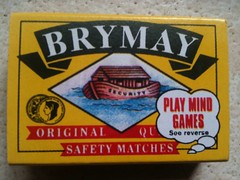
Price 18p for over 40 brown tipped safety matches in the traditional cardboard box. Made
in EU by the Swedish Match Company (they merged with Bryant & May way back in 1926) to form the world's biggest match company. You get a nice illustration of the Ark though matches would have been hard to strike in the deluge. Bit disappointed they didn't say Co-Op.
Matchbox labels from coophistorian on Flickr as a Slideshow, or as a Set (there are some pictures of co-op stores that have snuck in).
Related earlier post Co-Op Matches
They are a history of an everyday that barely exists in 2012. People don't need matches like they used to, and cheap disposable lighters came along for those who do need a flame.
In the recent past nearly everyone would have needed matches. Not just cigarette smokers, and pipe smokers needed more of them, but to start coal burning fires and ignite gas rings on the stove top. Plus you could do lots of puzzles and tedious party tricks with them.
Hence the marketing opportunity, and they didn't use terms like that, to advertise to your customers. Most of the matchboxes are for the CWS and the matches British Made. But there is a selection from long gone famous Co-Op Societies - e.g. Barnsley British, Brighton, Yorkshire, even Normid. Often these were made in Belgium. Products promoted include Federation Flour, Lutona Cocoa, Prescription Tea (forerunner of 99 tea) and some I'd never heard of like Purple Seal Margarine, Golden Ball Marmalade and Laundene that whisks the dirt away.
So the next time I went into the Co-Op shop I added a box to my
purchases. Not that I needed any. But just to see what was was still available.
Price 18p for over 40 brown tipped safety matches in the traditional cardboard box. Made
in EU by the Swedish Match Company (they merged with Bryant & May way back in 1926) to form the world's biggest match company. You get a nice illustration of the Ark though matches would have been hard to strike in the deluge. Bit disappointed they didn't say Co-Op.Matchbox labels from coophistorian on Flickr as a Slideshow, or as a Set (there are some pictures of co-op stores that have snuck in).
Related earlier post Co-Op Matches
Wednesday, June 27, 2012
Chutney of Empire
A relish from the Raj that made its appearance in Britain at the end of the 18th Century in the upper class households, and was adopted by successive classes to become a national condiment. Now every grocery store, faux farm shop, pseudo farmers market and delicatessan stocks the stuff.
Hobson Jobson, Yule & Burnell's 1886 glossary of Anglo-Indian words, cites chatna from 1813 and chatnee from 1820. From which you get the modern English spelling chutney. If you were wealthy enough you could buy imported chutney, or get cook to rustle up a batch that used apples and onions instead of mangoes and tamarinds. Recipes in Eliza Acton's Modern Cookery for Private Families ( 1845) or Mrs. Beeton's Household Management (1861).
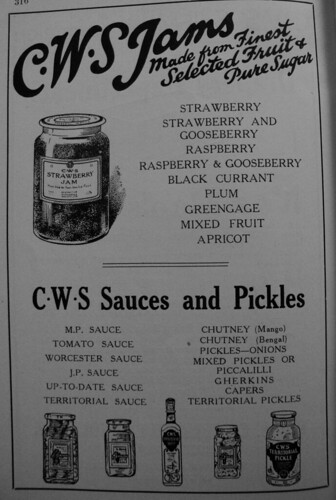
Moving on a bit prices fell, and production from every pickle and sauce maker increased. Here we have the CWS advert from 1926 which has a Bengal chutney (that's short hand for hot, just like the description Mexican these days), and a mild sweet mango chutney.
Green Label Mango Chutney by Sharwood's become one of the leading brands after WWI and it still is. You'll find in The Co-Operative store and just about everywhere else. Just check out the illustration from the 1920's. It might have been made in a factory in London but you've got a character out of the Arabian Nights giving it authenticity. Heinz made a tomato chutney - tomatoes were their ingredient of choice for ketchup, soup and beans. Crosse & Blackwell were also leading purveyors.
I do like some of the names the evoke the colonial period, still available when you track them down. Major Grey's Mango Chutney was supposedly named after some chap in the Bengal Lancers. The best is Colonel Skinner's Mango Chutney, now he was a real soldier in India with his own horse regiment.
Now I've tried to explain chutney to friends from the other European countries. They look puzzled when I explain it is like a spicy jam and goes particularly well with poppadoms or as an extra filling for a sandwich.
However what was once an exciting new food from the Jewel of the Empire has been adapted to modern tastes. That is sweet and homogenised. Loaded with cheap sugar from beet, and there are brands out there are using high fructose corn syrup, having a texture that is gloppy sticky paste. When you see it in squeezable plastic containers you've hit another nadir in good taste. When you get the watery let down served in restaurants you've been done again. Don't fret there are still good chutneys about.
On the home made chutney front it became the salvation for the glut of fruit and vegetables. Back in WW2 days the Ministry of Food issued information to make Green Tomato Chutney. It had been around for decades because unripe tomatoes are that blessing or curse of English summers. The adoption of a foreign food to become an institution is a fascinating development and we should be pleased it has happened. Why eat plain when there is a jar of chutney in the cupboard.
Links for further reading :
Hobson Jobson : Anglo-Indian dictionary online.
Military memoir of lieut.-col. James Skinner is available at the Internet Archive, but only the Google Books version appears to have all the pages. It's here.
Previous posts in the Foods of Empire series are these.
Sunday, June 17, 2012
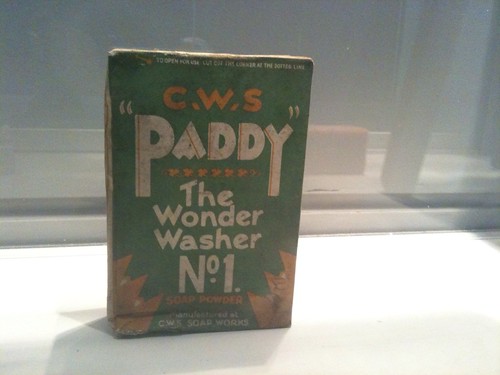
Paddy Soap Powder
Sometime ago I made a posting about Spel Washing Powder. I was taken aback how many views it has received. There you go publishing a detailed piece of research about some historical footnote, nobody is interested. But a pack shot of a long gone washing powder gets the hits.
Spotted this old packet in a glass case in Gallery Oldham. It is not often I venture to an old mill town. But there is a new direct tram route and there was an exhibition of Liam Spencer paintings. Combine it into an adventure on light rails. It rained all day.
Paddy washing powder I don't know much about. It was around in the 1930's and definitely into the 1960's. Made in Irlam and other CWS soap works, and sold in your local co-op store.
There was also a bar of carbolic soap and some dolly blue which you added to your wash for whiter whites in a small cabinet by the stairs on the first floor. Funny what gets curated and displayed and what doesn't.
Previous : Spel Washes Everything.
Spotted this old packet in a glass case in Gallery Oldham. It is not often I venture to an old mill town. But there is a new direct tram route and there was an exhibition of Liam Spencer paintings. Combine it into an adventure on light rails. It rained all day.
Paddy washing powder I don't know much about. It was around in the 1930's and definitely into the 1960's. Made in Irlam and other CWS soap works, and sold in your local co-op store.
There was also a bar of carbolic soap and some dolly blue which you added to your wash for whiter whites in a small cabinet by the stairs on the first floor. Funny what gets curated and displayed and what doesn't.
Previous : Spel Washes Everything.
Tuesday, June 12, 2012
Lump Salt
Old style provisions I find a fascinating field of discovery. When soap literally came in long bars and the shop keeper cut off a slice for the customer, and sugar came in a big cone. Those two ways of selling still exist. The soap store chain called Lush sells cut and weighed soap. The loaf sugar I've not seen in the UK but is still available in Germany. Cut cheese at the deli counter is one of the last items that is still sold to a customer from a larger block.
In the days before sliced bread there was also salt sold in lumps. We're back in the years pre-1930. You sometimes see in antique shops tiny spoons referred to as salt spoons. Not that I've ever questioned why there was ever a need for a salt spoon. Apparently it was for distribution of the broken up lump salt at the dining table.
You can see the irreversible trend since the Hardy Lane store opened in 1929. Provisions, both food and non-food, have become sliced, diced, packaged and ready for use. Who is going to crush salt and pass the spoon these days. It has actually gone beyond that. Today you see chopped vegetables in plastic on sale in the chiller cabinet, and frozen roasted potatoes and the Yorkshire puddings to go with them.
In the days before sliced bread there was also salt sold in lumps. We're back in the years pre-1930. You sometimes see in antique shops tiny spoons referred to as salt spoons. Not that I've ever questioned why there was ever a need for a salt spoon. Apparently it was for distribution of the broken up lump salt at the dining table.
You can see the irreversible trend since the Hardy Lane store opened in 1929. Provisions, both food and non-food, have become sliced, diced, packaged and ready for use. Who is going to crush salt and pass the spoon these days. It has actually gone beyond that. Today you see chopped vegetables in plastic on sale in the chiller cabinet, and frozen roasted potatoes and the Yorkshire puddings to go with them.
Friday, June 8, 2012
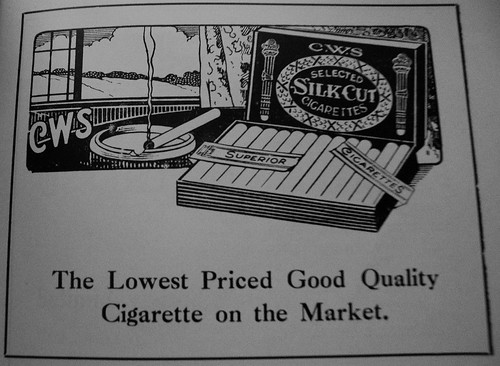
Original Silk Cut pre-WWII
Silk Cut as you will know is a best selling brand of cigarette for the last twenty or more years. A 75-25 mixture of blonde tobacco and cytrel. It was made by Gallaghers which was bought by Japan Tobacco. So was a little puzzled by this CWS display advert from the 1920's.
Oh how times have changed. The co-operatives took a temperance line over alcohol and manufactured acceptable tobacco products. But alcohol now is faced up on whole isles in the stores, the CWS tobacco factory in Manchester was converted to appartments whilst the evil tobacco is disappearing behind closed cupboard doors. Already been to a few shops like The Co-Operative in Holmfirth, and Waitrose in Cheadle were the hidden policy is in effect.
Advert is from the People's Year Book 1926 published by the CWS, Manchester.
Sunday, June 3, 2012
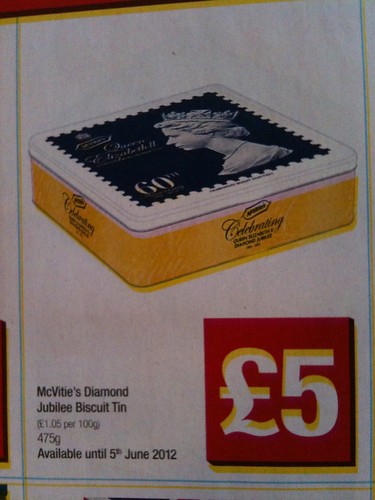
Royal Biscuit Tins
Whenever you have a royal event then biscuit manufacturers get the tins painted up for the occasion. The Diamond Jubilee follows in this tradition. Advertisement (left) is from this week's glossy leaflet from The Co-operative that arrived with the free newspaper. Sure enough they were on the shelves in the shop. Bit tempted by a McVities. Oh how we like McVities. I wonder if they were made at their factory over in Levenshulme?Wind the clock back 59 years to the Coronation and you have CWS biscuits manufactured at both their Cardiff or Crumpsall works. A collectors item and that's without you seeing the reverse side with an image of a dashing Duke of Edinburgh.
Royal biscuits date back to at least Queen Victoria with Huntley & Palmer making the Osborne in 1860 named after the big royal house on the Isle of Wight. There may have been Jubilee biscuit tins in her time.
Carr's made "Coronation Biscuits" with a vanilla flavour for Edward VII in 1902, and Huntley & Palmer produced "Royal Sovereign" filled with apricot jam for George V in 1912.
Note the decent interval of a year from the death of the last monarch to baking biscuits for the new one. When it came to Edward VIII the souvenirs for the forthcoming Coronation were in the shops in 1936. As we know it didn't take place, and George VI got the crowning in 1937, and the biscuit tins were in the stores. The CWS got the production lines rolling for commemoratives too.
There was a Silver Jubilee for George V in 1935. Those on unemployment benefit, and there would be many without a job received a little extra shilling, and 2/6d for under 14 dependents to mark the occasion. There has been no mention of a little extra for this year's event. However biscuits featured in the parties. "A gift of 30,500 caskets of biscuits has been made by Sir Alexander Grant for distribution at Jubille celebrations throughout Edinburgh" - Manchester Guardian 20th April 1935.
From the Coronation in 1953 the souvenir bandwagon has increased for each wedding, and now the third jubilee even more....
Now if heritage biscuit tins are for you then may I suggest you check out British Biscuit Tins with a searchable database and colour photographs.
The other good link is the Facebook page of the Museum of Brands, Packaging and Advertising. It is a trove of nostalgia. They have an exhibition ‘Jubilee, Jubilee’ which runs to 31st August 2012. Should you be in Notting Hill, London I recommend a visit, you won't be disappointed seeing the cornucopia of artifacts.
Thursday, May 31, 2012
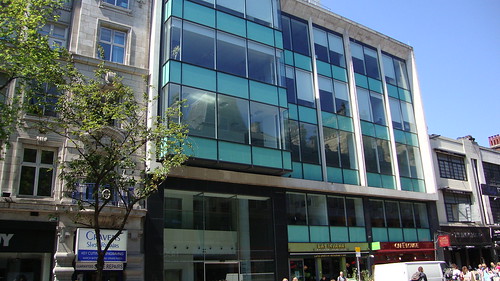
New Deansgate House Co-Operative Emporium
A little diversion into the centre of Manchester. Prompted by a question posed underneath a photograph I uploaded to Flickr. Where was Deansgate House? So a little story about New Deansgate House, a co-operative venture about few buildings north of the famous Kendal Milne building. It was at 84 Deansgate, Manchester.
The building is still there, and it's an architectural gem if you haven't set your head against the modernist style.
Though Manchester was the headquarters of the co-operative movement it never had a department store in the city centre. In 1945 six local co-operative societies and the wholesale society formed the Co-Operative Emporium Limited. Beswick, Blackley, Failsworth, Manchester & Salford, Pendleton, and Prestwich joined with the CWS. The following year the CWS acquired the Deansgate Arcade. One of the those fine Victorian versions of shopping under one roof with small upmarket shops fronting a passageway that ran from Deansgate to Parsonage Gardens. There are some fine examples in Leeds.
But it wasn't until 1955 that last tenants left and the old building was demolished for a bright vision of the future.The architect was George S. Hay of the CWS. He later went to design with Gordon Tait the prestigious CIS Tower & New Century House on Miller Street opened in 1962.
Essentially New Century House is a steel frame constructed by Edward Wood & Co at the Ocean Ironworks in Trafford Park and lots of glass was put around it. This was new for Manchester. The cost is reported as £500,000. It opened on the first day of spring, that'll be Saturday 21st March 1958 by Leonard Cooke the chairman of Co-Operative Emporium Ltd.
A whole five floors, no food department, but furnishings, fashion, gramophone records, and a cafteria. The Co-Op Bank then a small banking operation of the CWS with no branches opened its first mini bank here on Monday 20th October 1969. An early example of in-store franchise.
But the venture was not a massive success that the co-operative hoped and planned for. Whatever the reasons for its slow decline - wrong stock, unfashionable image or prices - I will have to investigate.
There is a lot to discover and the Co-operative Emporium Limited archives are kept at the Greater Manchester Records Office. The company ceased and was de-listed as an IPS in July 1973. At least we still have the building which is a miracle for a city that is always being re-built.
Sunday, May 27, 2012
Back to the Railway Arch
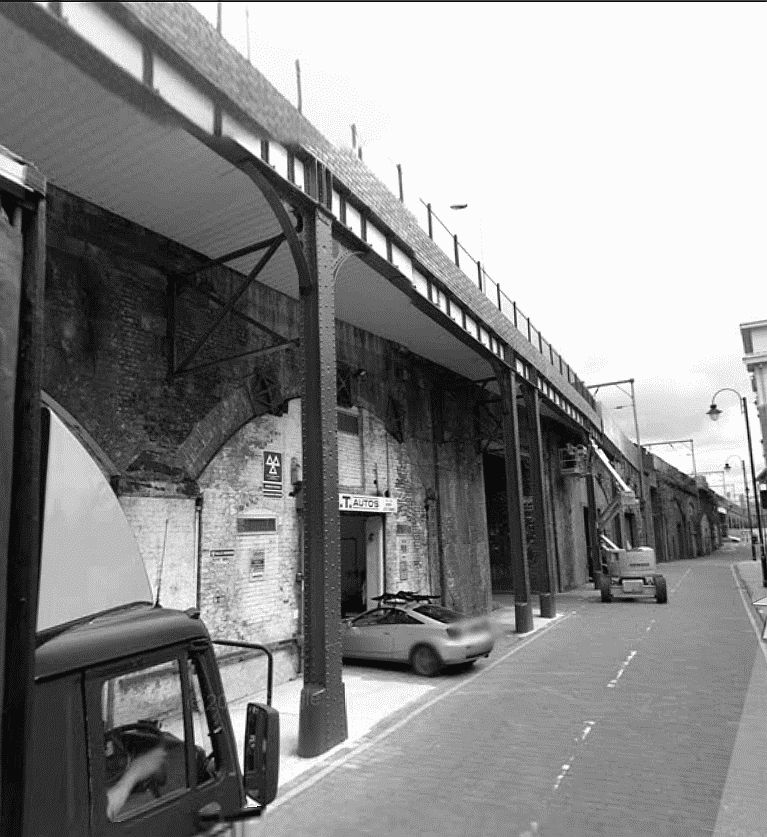
Underneath this arch there was a conference to form the CWS that met on a snowy Christmas Day in 1860. The story is in a previous post. The arches are there, the temperance hall in one of them has been replaced by a motor repair business. There is no blue plaque that highlights the event. The other places where other conferences were held to form a wholesale society have been demolished. The public hall in Ancoats, and the Jumbo Farm in Middleton.
What you are looking at is Hewitt Street, Manchester with a railway viaduct between Oxford Road Station and Deansgate Station. Should you ever be meandering up there the arch is just before Rowendale Street (used to be called Rowe Street) as you walk eastwards towards City Road. Top photograph is from "The story of the C.W.S.; the jubilee history of the Co-operative Wholesale Society Limited, 1863-1913" by Percy Redfern and dates from around 1912. It is available at the Archives.Org
Subscribe to:
Posts (Atom)
You can email : coop AT biffadigital.org with any information that will help in the making of this history.