Showing posts with label Shopping. Show all posts

Sunday, October 27, 2013

Co-Op First Self Service UK


If you browse for finding the first self service store in Britain then you'd have to dig very deep to find any mention of a co-operative bringing the concept from the USA to the UK. There was a recent three part documentary on shopping and retailing by the BBC and any part that the CWS or any co-operative society played in any retail innovation was seriously omitted.

The first own label goods are by the CWS date from 1873 and the use of own manufactured goods to beat the restrictions of Retail Price Maintenance are from 1906 with some patent medicines, and better known the Defiant Radios in 1933.

Now to the first self service grocery, it wasn't J.Sainsbury or Tesco but the London Co-Op Society who opened a small section in a Romford department store in 1942. Apparently introduced to alleviate staff shortages during the war. The first stand alone self service shop in Britain goes to Portsea Island Co-Op in March 1948. It's one of those great trivia facts that the city of Portsmouth is actually on an island linked by bridges to the English peninsular. Portsea island being the third most populated island the British Isles.

The London Co-Op Society sent a delegation to the USA and Canada as early as 1938 to study the self service format. The CWS sent a research team to the USA in 1947, and published guidance on how to run a self service outlet in 1949. The M&SE (Manchester & Salford Equitable) took to idea and started altering its existing stores the following year. Eventually the format came to the smaller stores like Hardy Lane in 1959.

 [ Information from the letter pages of the Co-Operative News in October 2013 ]

Thursday, February 14, 2013

Co-Op Check Tin


So you stumble over some item for sale, puzzled by the object and curiosity wants answers. Said item is a co-operative check tin possibly from the 1920's. It's not made by a co-operative but is made for co-operative shoppers to keep little slips of paper safe. On paying for their purchases customers were given a small paper receipt with the amount spent and their membership number.

I suppose some would keep these safe and calculate if their dividend on purchases had been tallied correctly. I suspect not many could be that bothered and accepted the dividend listed by the co-op head office.

Nostalgic history forums always quote people who can still remember their divi number of the family. It was ingrained into memory at an early age, for ever, and is recited for life.

Metal boxes were given away to promote a company's products. Who doesn't like a bright useful tin to keep safe items and make homes tidy. This one came compliments of Hargreaves Brothers & Co. and maybe dates from the 1920's. It's four sides announced that you must remember to buy the following :- Linoleo Floor Polish, Gipsy Black Lead, Ocean Blue in squares & Bags, and Glosso Metal Polish. An age of coal powered grime and relentless cleaning. Note those brand names they end in the letter "O". As in Brasso, Silvo, Zeppo and so on.

Hargreaves Brothers and Co started as makers of black lead and metal polish in Gipsyville which is in Hull way back in 1868. When this tin was issued the company may have been taken over by Reckitts & Son in 1922. An even older Hull company, founded in 1840 that also made starch and cleaning products.

Whether any of these products were sold alongside the CWS own brand, can't say. You get the impression from co-op histories that only CWS goods were sold but that wasn't the case. Leading brands and own brands did stack side by side in the stores. It's that co-operative magazines and advertising promoted CWS products. Very likely Glosso was available at your local co-op.

Monday, November 12, 2012

Nearly A Century and a Half


2013 marks the 150th Anniversary of the CWS (now known as The Co-Operative Group). No doubt there will be some sort of event or at least a booklet to mark the occasion.

The picture shewn is from the centenary year of 1963 and depicts a gentle world of shopping. The lady is nicely dressed to collect a few groceries in her wicker gondola basket and the door is held open by possibly the manager of the shop attired in his white coat.

For the year the CWS adopted the word "Centurywise" and produced posters and badges announcing such. They also produced a film which was exhibited by the numerous retail societies. Obtaining a copy in a modern digital format might prove difficult.

Also celebrating 150 years is the Football Association and they have already announced their dinners and friendly international matches with Brazil, Scotland and Ireland to mark the year. But considering it is the national game you won't find an events in your town as they don't like to leave London.

The successors of the CWS may take a more countrywide view.

Previous related posts
Under A Railway Arch
150 Years in 2013

Monday, October 1, 2012

Pic-Nic 1934

There is something charming about the picnic. Been checking out what you would have had back in the 1920's and 1930's. The CWS advert here dates from 1934 and reads like a typical salad dinner you would eat in the summer months.

Not quite the Enid Blyton "Famous Five" (written between 1942 - 1962) who would have had lashings of hard boiled eggs, tomato sandwiches, lemonade, tinned sardines, melt-in-the-mouth shortbread, radishes, Nestlé milk, ginger beer, tins of pineapple chunks, squares of chocolate....

Modern times it could be olives, hummus, fresh peaches and chilled Prosecco from a cooler box. Your mileage may differ. Tupperware boxes of salad or those triangle sandwich packs sold at petrol stations. Maybe the invented traditional of the Ploughman's Lunch.

The advert has a quaint age of innocence. It is old style ready to eat food. If you wished to recreate a 1930's picnic using some of these products then it possible to find current brand equivalents. The fruit squash drink are not yet extinct. Spotted some of those meat paste items at the local co-op. Not a prominent item but still on the shelves. Tinned fruit is a relic when fresh strawberries, albeit not very tasty strawberries, are sold in January.

But the illustration makes it all look spiffing good fun. No wet grass then. Hey, ho we'll all off to scoff  'en plein air', and play some ball games or frisbie afterwards. That's the bit when people think it is pretty smart to do throw and catch.

But the romance of the picnic is still with us, even though the weather hasn't been clement this summer.

The photograph is a colour photograph of a picnic on Stanmore Common in London, taken by R E Owen, 20 May 1929. It's from the National Media Museum which is in Bradford...it looks just how a picnic should with the wicker basket, rugs on the ground and possibly proper glassware...

Further reading : A brief history of the picnic.

Monday, July 16, 2012

Co-Op Matchbox Labels

A whole series of pictures of matchbox labels was recently uploaded to Flickr by coophistorian as a contribution to Co-Ops Fortnight 2012.

They are a history of an everyday that barely exists in 2012. People don't need matches like they used to, and cheap disposable lighters came along for those who do need a flame.

In the recent past nearly everyone would have needed matches. Not just cigarette smokers, and pipe smokers needed more of them, but to start coal burning fires and ignite gas rings on the stove top. Plus you could do lots of puzzles and tedious party tricks with them.

Hence the marketing opportunity, and they didn't use terms like that, to advertise to your customers. Most of the matchboxes are for the CWS and the matches British Made. But there is a selection from long gone famous Co-Op Societies - e.g. Barnsley British, Brighton, Yorkshire, even Normid. Often these were made in Belgium. Products promoted include Federation Flour, Lutona Cocoa, Prescription Tea (forerunner of 99 tea) and some I'd never heard of like Purple Seal Margarine, Golden Ball Marmalade and Laundene that whisks the dirt away.

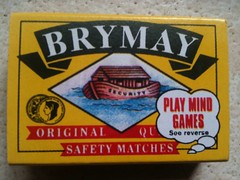
Safety Matches So the next time I went into the Co-Op shop I added a box to my purchases. Not that I needed any. But just to see what was was still available.  Price 18p for over 40 brown tipped safety matches in the traditional cardboard box. Made in EU by the Swedish Match Company (they merged with Bryant & May way back in 1926) to form the world's biggest match company. You get a nice illustration of the Ark though matches would have been hard to strike in the deluge. Bit disappointed they didn't say Co-Op.


Matchbox labels from coophistorian on Flickr as a Slideshow, or as a Set (there are some pictures of co-op stores that have snuck in).
Related earlier post Co-Op Matches

Sunday, June 3, 2012

Royal Biscuit Tins

Jubilee Biscuits
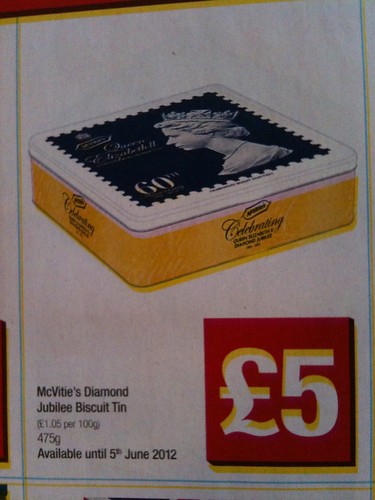
Whenever you have a royal event then biscuit manufacturers get the tins painted up for the occasion. The Diamond Jubilee follows in this tradition. Advertisement (left) is from this week's glossy leaflet from The Co-operative that arrived with the free newspaper. Sure enough they were on the shelves in the shop. Bit tempted by a McVities. Oh how we like McVities. I wonder if they were made at their factory over in Levenshulme?

Wind the clock back 59 years to the Coronation and you have CWS biscuits manufactured at both their Cardiff or Crumpsall works. A collectors item and that's without you seeing the reverse side with an image of a dashing Duke of Edinburgh.

Royal biscuits date back to at least Queen Victoria with Huntley & Palmer making the Osborne in 1860 named after the big royal house on the Isle of Wight. There may have been Jubilee biscuit tins in her time.

Carr's made "Coronation Biscuits" with a vanilla flavour for Edward VII in 1902, and Huntley & Palmer produced "Royal Sovereign" filled with apricot jam for George V in 1912.

Note the decent interval of a year from the death of the last monarch to baking biscuits for the new one. When it came to Edward VIII the souvenirs for the forthcoming Coronation were in the shops in 1936. As we know it didn't take place, and George VI got the crowning in 1937, and the biscuit tins were in the stores. The CWS got the production lines rolling for commemoratives too.

There was a Silver Jubilee for George V in 1935. Those on unemployment benefit, and there would be many without a job received a little extra shilling, and 2/6d for under 14 dependents to mark the occasion. There has been no mention of a little extra for this year's event. However biscuits featured in the parties. "A gift of 30,500 caskets of biscuits has been made by Sir Alexander Grant for distribution at Jubille celebrations throughout Edinburgh" - Manchester Guardian 20th April 1935.

From the Coronation in 1953 the souvenir bandwagon has increased for each wedding, and now the third jubilee even more....

Now if heritage biscuit tins are for you then may I suggest you check out British Biscuit Tins with a searchable database and colour photographs.

The other good link is the Facebook page of the Museum of Brands, Packaging and Advertising. It is a trove of nostalgia. They have an exhibition ‘Jubilee, Jubilee’ which runs to 31st August 2012. Should you be in Notting Hill, London I recommend a visit, you won't be disappointed seeing the cornucopia of artifacts.

Saturday, February 11, 2012

Before Self Service

Northenden co-op branch 1950
I've not discovered any pictures of the inside of the Hardy Lane Co-op store as it was before the modern era. However I came across some poorly reproduced indoor photoraphs of similar branches of the Manchester and Salford Co-op. Taken around 1950 just before they introduced the self-service format. First is the Northenden store, below is Sale Moor store. This was how shopping for groceries was done. You had to queue, then you had to ask for each item unless you handed over a shopping list. At least most of the items were pre-packed and you didn't have to wait for someone to have a quarter of tea weighed, then the flour bagged up etc....as it was in earlier times. Bacon, ham and cheese were still cut to your request.

Sunday, August 15, 2010

Shop Opening Hours


These are the opening times of Co-Op stores in Manchester in 1930, and would have been the original trading hours for Hardy Lane store. I was going to copy them into type but a photo from an old handbook will suffice. Up until about thirty years ago closing for lunch was still the norm. An hour and a quarter for a midday break would now be considered generous. Saturday was the exception. Early closing day as laid down by the Shops Act 1911 was on a Wednesday. Even now in Chorlton many independent shops still close early on a Wednesday, some don't even open for the day with it being the quietest trading day for customers. Sunday opening would have been unthinkable back then but that all changed with the Sunday Trading Act 1994.
You can email : coop AT biffadigital.org with any information that will help in the making of this history.