Monday, April 30, 2012

Garibaldi at the Co-Op

Garibaldi biscuits
Garibaldi visited England in April 1864. He was world famous before the yacht landed at the Isle of Wight, he was a sensation when he stayed in London. [ Now before you read more can I point out that his name is pronounced Gary-Bal-Dee ]. Everyone wanted to meet him, he drew massive crowds at speaking engagements and received hundreds of invitations.

Manchester wanted him to visit. A Manchester Working Men's Garibaldi Reception Committee was got together and the Free Trade Hall was going to be the venue. However the legendary hero left abruptly, supposedly on ill-health grounds but really under pressure from the British Government. Whilst it had suited British foreign policy to remove the Austrians from the Italian states and have a unified new country it didn't want a radical, inspirational revolutionary touring the industrial provinces. Garibaldi's notions of democracy, emancipation, freedom and women's rights were not on the political agenda of the ruling classes.

So what do we have. Italy has thousands of squares, roads and statues to the great man. Britain has a biscuit originally produced by Peak Freans in 1861. A type of blouse and shirt popular then but not seen now. Also the colours of Nottingham Forest football club who adopted red in honour of the Garibaldi's irregular army of Red Shirts. Arsenal play in red because Forest gifted them a full kit years later.

However disappointed as the people of Manchester were the M&SE Co-Op produced an hagiographic address which they forwarded to our hero.

Saturday, April 28, 2012

IYC 2012...more

International Year of Co-operatives
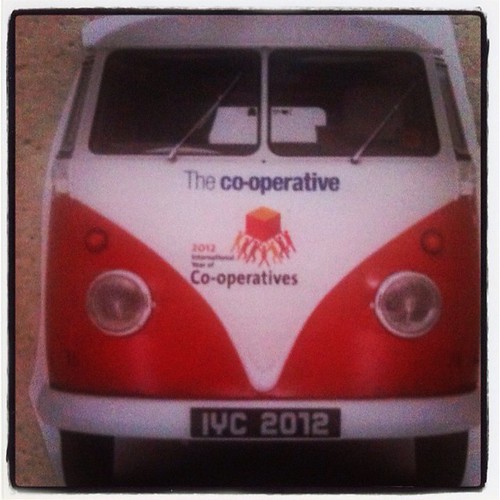
I don't suppose this smart new camper van, drop in the words iconic and retro at this point, will be visiting Chorlton but it is touring the nation. All for the promotion of the International Year of Co-operatives 2012. It'll be in Manchester on Saturday 5th May. At the People's History Museum at 1000, and MOSI at 1400. You can find out more and if it is visiting your bit of the country at http://www.co-operative.coop/smiletour

Family Fare

Untitled
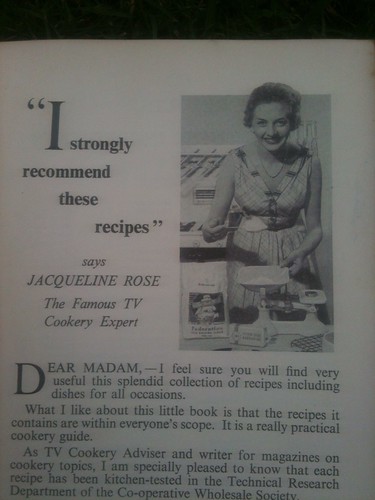
Acquired an old cookery book last week. Not that I need anymore I've got two big shelves full of them. But this is Family Fare published by the CWS around 1955. It is of its day with a company's products mentioned on every page. For example use four ounces of CWS Silver Seal margarine and 2 ounces of CWS Federation S.R. Flour. The book addresses the woman of the house who wants to produce cakes and savouries for the family. Well women lost their job when they got married in those days and were expected to be little home makers. There are two pages on cooking herrings with a recipe for every month. Some more on Continental Cookery - Croquettes aux Crevettes from Belgium, Chicken Maryland (USA), Mousssaka a la Bos (Greece) for it doesn't have aubergines in it. Well there were no aubergines in Britain for at least another 20 years...
Other sections include jam making, home wine making and toffee. As some one who makes the odd loaf of bread I was puzzled by the CWS Federation flour being used for both making pastry and making bread. These days we have a plain flour and a strong bread flour.

I can't find any information on the famous TV cookery expert in the picture. But around that time the CWS put on exhibitions called Family Fare in cities in England and Wales. You'd have stalls, brass bands, and fashion parades.

Note also the CWS logo from the 1950's. It represents a wheatsheaf but I always think it looked like a thumbprint.

Friday, April 27, 2012

Tribune Archive

Over the years I've subscribed to many a left-ish magazine for a year or so. Some are still around New Statesman, Tribune and Red Pepper. Some have disappeared from the newsstands - Labour Weekly, New Socialist and others I don't recall.

Anyway there is a great archive of articles from The Tribune 1937-2011. It's every political battle for over 60 years. It is searchable, and as ever I put in the word "co-operation". The returns run into hundreds. Everything from Co-operative Party Conference reports, the need for mergers, and the links with the Labour Party. You might prefer the landmarks of Pearl Harbour, Miners Strike, Berlin Wall or the Tet Offensive. It's all there with those typos that come from digitizing print media to e-media.

There is a whole series "At the sign of the Wheatsheaf" which runs throughout the 1950's and 60's - one of those editorial advertisement features about current topics with a plug for CWS products. You'll need the link. Here it is : archive tribune.

Thursday, April 26, 2012

Co-Op Farms

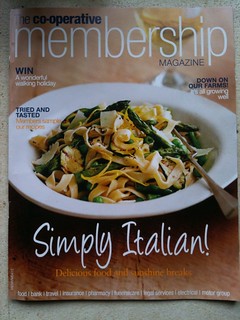
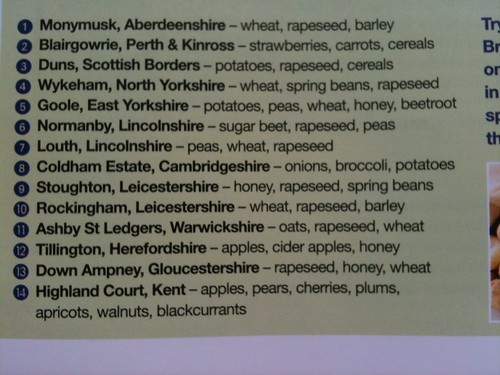
Co-op Membership Magazine The Co-operative magazine for all members arrived yesterday. I think it is published quarterly. An easy light read of recipes, offers, and travel. This one had an informative article about Co-operative Farms, all 50,000 acres of them.

I was surprised that the biggest crop was wheat. Also that half the rapeseed crop is used for bio-fuel to heat the head office in Manchester. How long has this been going on?

This is big scale agriculture but it was interesting to see where the produce that is clearly labelled British in the Co-operatives 2,801 stores.

Pictures are from the magazine, and as ever they have been uploaded to Flickr.

Co-op Farms

Wednesday, April 25, 2012

Sauces of Empire

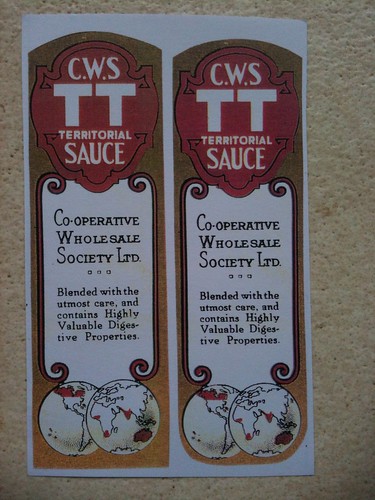
TT sauce CWS If there ever was a sauce of the Empire it would have to be Lea & Perrins Worcester Sauce, born in that town in 1837. It has the ingredients of Empire - sugar, molasses and tamarind. Though most people in Britain wouldn't know what tamarind looks like or that comes from India. But they've certainly tasted it for it also in the biggest brand of table sauce - HP Sauce. House of Parliament on the label, a favourite of Prime Minister Harold Wilson and now made in the Netherlands. That says what happened to Empire. It was overtaken by global capitalism and multi-nationals.

The picture is of TT sauce made by the CWS. It was around in the time of WWI, maybe even later. Now the Empire is shown on the hemispheres with the Dominions, the Raj and a colony. Not the East African acquisitions of Rhodesia, Uganda, Kenya etc. Ceylon isn't even on the map.

There were lots of sauces in bottles and usually they had two initials for their name. The CWS also had one called JP Sauce which carried on until at least the late 1950's. Unfortunately I've only got this bad reproduction of a TT Sauce label and no ingredient list. I have a theory why bottles of sauce have always been popular. It goes bland food, and making your own sauce for your meal is a step too far in skill or time. So reach for the bottle and liven up your plate with a consistent condiment.

This was No.6 in the Foods of Empire Series at the Co-Op.

Monday, April 23, 2012

Pop Up Demo

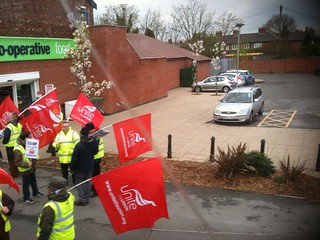
Unite MMP disputeUnite MMP dispute Usually it is history posts but I was passing by and hurriedly snatched some photos of a demonstration outside the Hardy Lane Co-Op store. By the time I returned after completing whatever it was I was doing elsewhere there was all quiet again. No evidence of any demonstration.

So what was it all about? Why were Unite members outside a branch of The Co-operative around midday on a Monday? But then I spotted an A5 small white sheet of paper on the floor. The other side revealed all....

There is a dispute in Bootle. MMP (Mayr-Melnhof Packaging) have locked out and sacked all their workers. Can you believe lock-outs, it's like the 1920's returned..what happened to rights under law?

What does Unite want?
"For the Co-Op to honour its commitments under the ETI Base Code and intervene to ensure that MMP respect the rights of its British workforce and return to the negotiating table in good faith." That's what the leaflet stated.

Sunday, April 22, 2012

Origins of M&S


The story of a meeting by the young men of the Roby Brotherhood on Christmas Day 1858 is given as the start of the Manchester & Salford Equitable Co-operative. I quite like this artists impression of one of their meeting made 100 years later. But deep down you know it paints a myth of how it was.

The chaps were mostly in their late twenties and early thirties. Working men, young dads, who attended the Roby Chapel, a noted Congregationalist Church and Sunday School in Manchester founded by William Roby. They would have worked six days a week, so a Saturday off work for Christmas Day would have been most welcome. Though they would have lost a days wages. They met at a small house at 22 Pump Street, Manchester set amongst  mills, workshops and ironworks. Across London Road would have been a new railway station for Manchester (the one now called Piccadilly). Pump Street and most of this area was redeveloped at the start of the 20th Century when Whitworth Street and grander buildings were constructed. The old fire station was built on the site of Pump Street.

If you've ever organised a meeting then you'll know the getting enough seating is the first priority. You couldn't imagine a long table and lots of matching chairs like some upper middle class dinner party. Well not in small terraced abode on narrow cobbled street. The room would have been packed.

Anyway they decided to form a co-operative on the lines of the Pioneers of Rochdale who had already been successfully trading for 15 years. They would rent a shop and when they had raised £100 and had 100 members it would open. Six months later that plan came to fruition. On the 4th June 1859 the shop opened at 168 Great Ancoats Street.
You can email : coop AT biffadigital.org with any information that will help in the making of this history.