Wednesday, February 15, 2012

Hardy Lane 1929


Just a picture from Tuesday October 29th 1930. Quality a bit poor, clipped from a newspaper, what wouldn't you give to get the negatives?

It shews Hardy Lane being transformed from a narrow country lane to wide road. New houses from the Barlow Moor Estate have been built. But are those old farm buildings the right foreground? Can't tell without further recognisance. It was planned to create "Arterial Route No.10" out of Manchester. It would have taken the dual carriage way of Mauldeth Road West built 1922-24, down Hardy Lane and then across the River Mersey to Sale and Altrincham. As we know this plan made Hardy Lane a very cul-de-sac as the road construction stopped at The Meadows.

Thanks to the commentor below. This is a photo of Hardy Lane looking towards Barlow Moor Road. The buildings on the right are the Hardy Lane Cottages - see http://www.oldchorlton.me.uk/15.html

Tuesday, February 14, 2012

Soft Drinks for the duration


You go down the store for a bottle of your favourite refreshing fizzy drink, only to find them replaced by cordials or concentrates. This was the position during WW2.

"In order to set free more factory space and more labour for the war effort and to save fuel and petrol, Lord Woolton has reduced by a large percentage the amount and variety of 'soft' drinks that may be manufactured" - Manchester Guardian, Saturday19th December 1942.

The Ministry of Food ordered the closure of many soft drink factories with some being turned over to aircraft production. Those manufacturers that remained produced bottles full of red, yellow, and orange concentrate. The Vimto factory in Manchester produced a deep purple version. The return of empty bottles was also encouraged due to a shortage of glass. The Soft Drinks Industry (War Times) Association Limited (SDI) ran the operation from 1942 through to 1948.  After that the various brands Schwepps, C.W.S., Kia-Ora & etc returned to shelves.

A little research into the wartime National Loaf, officially known as National Wheatmeal Bread, led to discovering National Cheese, and now SDI Drinks. I wonder what else will be stumbled upon in the range of foods restricted in the national interest.

Monday, February 13, 2012

Canned Retro Food

Tins
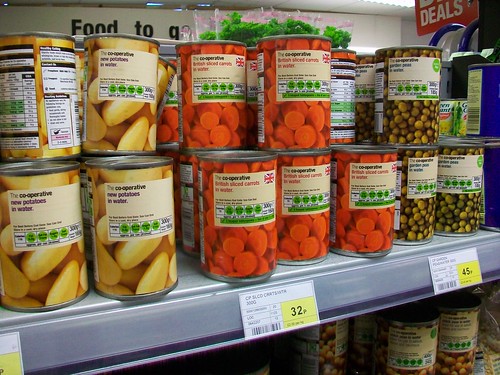
The demise of canned food has been predicted for sometime. Some sectors are in terminal decline - tinned fruit, rice puddings, sauces, custard. It's those more attractive forms of packaging like resealable pouches, cartons, and glass that makes cans look old school.

Tinned Potatoes
Now tinned new potatoes are old school, and occasionally I buy them but it feels like a culinary offence worthy a suspended custodial sentence. They were the standby for the "hunger gap" when what was left from the last of autumn crop and the first of the new season. Now those lean months are covered by imports from places warmer and a lot further south - Egypt, Cyprus, and Sicily. They are also the standby for the can't cook won't cook types...

Baked Beans remain the biggest seller in the canned vegetable department. Their sales march ever onwards. Britain is the biggest consumer of them in the whole wide world. True story and it is one I point out to those misguided folk who deny baked beans. Ellen MacCarthy sailed solo around the world in the fastest possible time, it was back in 2005, and I followed every piece of news as it progressed. It was some achievement. First meal back in Blighty, beans on toast with the family on the yacht. It's that much part of the national pysche.

Links : Food Manufacturing : The decline and fall of canned food

Photo credits from Flickr: Co-op Historian (top); Lorenzo23 (bottom)

Sunday, February 12, 2012

Co-Op Matches

That e-Bay always has interesting things for sale. How about these old match boxes, current bid over 11 GBP. These look like south of England matches, the box from Enfield Highway Co-op may the give away. In the north we've always preferred red top strike anywhere matches over the dark blue safety match. But they no longer manufacture matches in Britain. The factory in Bow, London where the famous match girls strike took place in 1888 has been converted to apartments.

National Loaf...more

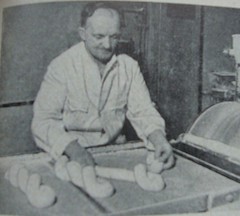
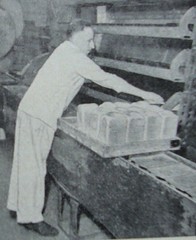
Co-op Bakery 1950Co-op Bakery 1950
If you study history you realise it is never complete. To most what happened in the past is cut, dried and pressed into a series of memorable or not so memorable dates. For the historian you always want to know more. So it is when I got distracted by the story of the National Loaf introduced in WW2. This is an update from a previous post called National Loaf....

The real name is the National Wheatmeal Bread (1942-1956), the term National Loaf is one coined after the war. There was also a National Cheese which was rationed, some months at just 2 ounces (56.6 grams) a week. It was processed and homogenised in the cheddar style. Also National Dried Milk which came in large tins introduced in the winter of 1941. Times were tough on the food front...and then you had to make something from dried egg powder.

The M&S Co-op version of that National Wheatmeal Bread was called the Golden Twist loaf and we know it was still being made in 1950 from this trumpted article..." The result is the famous Golden Twist loaf. Its colour a rich nut brown, its crust delectable, its texture perfect. Just try one out on the kiddies, and they will clamour for more."1
Then made at the Manchester and District Co-operative Bakery which was formed after the war as a joint venture by the M&S, Beswick, and the Blackley Co-op Societies who were baking off 1,600 loafs an hour. So brown bread wasn't that unpopular. Some or most of these would have been at the factory on Cakeloaf Street in Ardwick. What a great name, who came up with that? Just off Ardwick Green, around the corner from the M&S head quarters. This co-op transfered its engagements, a phrase much used in co-op business to cease trading because of financial difficulties, to the CWS in 1961.

Still work to be done. Re-create the National Loaf...it's nothing special if you can make your own bread. Not rocket science but just four ingredients, a hot oven and 3,000 years of history.

1. Manchester and Salford Monthly Herald April 1950, page 86

Saturday, February 11, 2012

Before Self Service

Northenden co-op branch 1950
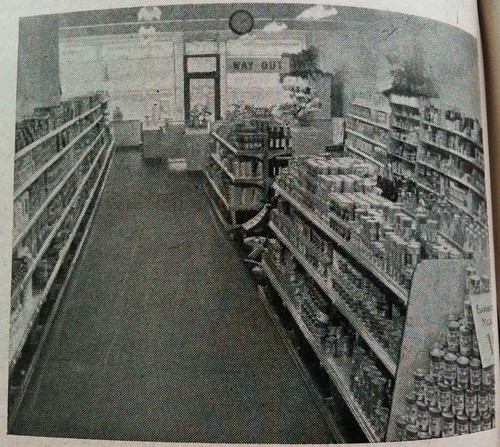
I've not discovered any pictures of the inside of the Hardy Lane Co-op store as it was before the modern era. However I came across some poorly reproduced indoor photoraphs of similar branches of the Manchester and Salford Co-op. Taken around 1950 just before they introduced the self-service format. First is the Northenden store, below is Sale Moor store. This was how shopping for groceries was done. You had to queue, then you had to ask for each item unless you handed over a shopping list. At least most of the items were pre-packed and you didn't have to wait for someone to have a quarter of tea weighed, then the flour bagged up etc....as it was in earlier times. Bacon, ham and cheese were still cut to your request.

Wednesday, February 8, 2012

National Loaf

National Loaf
The National Loaf was introduced to Britain in 1942 due to a shortage of shipping space for flour from Canada and the USA. It was sold unwrapped and unsliced to save packaging. There are references to it being sold a day old despite bread being best when fresh as possible. White bread was then no longer produced so if you wanted bread you bought the National Loaf.

Sunday, February 5, 2012

Self Service 1950

Self Service was a retail format introduced into Britain from the USA around 1949. It came to Chorlton in the summer of 1950. In a long running programme the M and S Co-op rolled out the aisles and wire baskets to the branches. It took a further nine years for it appear at the Hardy Lane store.
Self Service 1950
These photos are in an article "Toasting Self Service", about the success of new way of shopping in the Chorlton branch. They are very likely have been photographed at the branch at 349-351 Barlow Moor Road. It was in the red brick building next to the Royal Oak. Quoting from the story...

You can email : coop AT biffadigital.org with any information that will help in the making of this history.