Monday, April 29, 2013

Northmoor Road


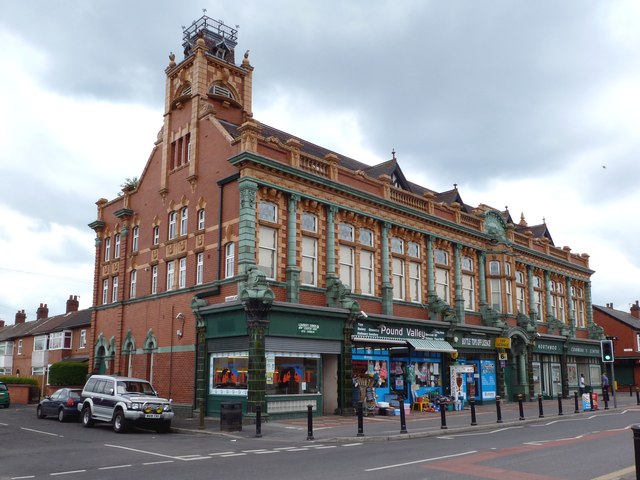
The old co-op building on Northmoor Road in Longsight, Manchester M12 5RT is an impressive building. Enough to be classed as a Grade II Listed Building in 1994. The other week it celebrated its centenary, only a few months late as the date on the building states 1912.

It was built for the Beswick Co-operative Society, founded in 1892, and a thorn in the trading area of the Manchester & Salford Equitable. The Beswick ignored any territorial agreements and would open branches were they felt they could do business. Thus districts like Levenshulme, Ancoats, Withington and Didsbury would have rival co-op stores.

Northmoor Road, originally called North Road was developed between 1899 thru to the 1930's. The most famous person to reside there was J.R.Tolkien between 1926-1947. We don't know if he went to the co-op for his tea and biscuits between writing another page of The Hobbit or Lord of The Rings.

Beswick Co-op building
The building rises up to two floors plus attic rooms in a square tower. It used to have a meeting room used as ballroom for dances to live music. The property is now owned by Great Places Housing Group who provide affordable, social and supported housing across the north west and Yorkshire.​​​​​​​​​​​​​ There is now a community centre and small business units on the ground flour. Apartments are on the upper levels. It's not every building that has a party by local residents to celebrate its 100th birthday. It was reported in the local newspaper, "the co-operative building is loved by all in the area, and that showed with the amount of local residents who came to the event." - South Manchester Reporter 25th April 2013.

There is no doubt a lot of history to this building, it is something I must follow up someday.
Further reading : Northmoor Road (Wikipedia)
Description of the architectural features
(Images of England)

Photo credit to www.geograph.org.uk

Sunday, April 7, 2013

Trams beyond Chorlton

Tram tracks Hardy Lane
The tram tracks are now being laid down the centre of Hardy Lane. Slowly the construction of the line to connect the airport with the centre of Manchester is coming along. I'm recording the progress with photographs.

As Hardy Lane is not a busy thoroughfare for cars reducing the road to single line traffic shouldn't cause any long tail backs. However the siting of the station at the junction of Mauldeth Road West and Barlow Moor Road might isn't ideal. Not ideal for foot passengers who will have to cross two main roads to reach the platforms. You have a similar situation in Droylsden and there are no cycle lanes to contend with there.

The picture below is from the Manchester Libraries Archives. It shews the tram times to reach the centre of town from the outlying districts in 1917.

Manchester Time Zone Map, 1917
Depending on which part of Chorlton-cum-Hardy you lived in it could take from between 20 minutes to 50 minutes to arrive at Piccadilly. It is maybe marginally faster on the Metrolink these days but then you have to factor in the time to walk to the station.

Friday, March 29, 2013

Twin tubs carry on

Daz
I'll draw your attention to a famous brand of washing powder and the words printed on the packet. The reference is to "twin tubs". Had I stepped into the past and not another shopping trip to the local Co-Op. Well apparently twin tub washing machines are still manufactured and presumably someone is buying them and Proctor & Gamble are marketing a washing powder to cater for that market. It is not widely promoted in the Daz range, it hardly gets a mention. What's the difference? This soap powder will make more suds so is unsuitable for an automatic washing machine.

Washing clothes that weekly chore that requires lots of hot water isn't the full drudge day of years ago. Well not when you have an automatic washing machine. So there must be some reasons why people still favour the machine of choice from the 1960's. Maybe it does a cleaner wash, or is eco-friendly besides being a cheaper capital purchase. The powder is also for handwash (not hand wash) and you can't go further back in history than laundry by hands.

Wednesday, March 27, 2013

Gramophone Music

barrynola 2
The history of recorded music is how it has progressively become cheaper and more convenient. You  don't even have to possess the physical object that holds the sound just some electronic device that can play it.  Literally bushels of songs at the fingertip. The advert is from the 1930's and the M&SE are stocking the new Barrynola gramophone. Note it is being demonstrated at a concert in one of the more salubrious suburbs of Manchester. A night out listening to records - no mention if dancing was allowed.

Interesting class dimension in that the Co-Op was appealing to not just the weekly struggle working class customer but to customers who had regular income with savings.

They were an expensive purchase not one for a struggling working family. A small portable would cost just under £3 (3 GBP), a cabinet model from £7 to £10. Then there were the new electric models using mains electricity. The new radiograms were also coming on the market, a status piece of furniture that would be desired for living rooms for the next twenty years. This was an age of developments in reproducing sound. Just as today there is that newer and better model available after you've paid your hard earned cash and taken delivery. Last year I purchased an iPod Nano that also doubles as a wrist watch. That model has been superseded, and my Zen MP3 player is ancient. We've not even gone into the junk room to find museum pieces like the Walkman.

The co-op society did hire gramophones and the Womens' and Mixed Guilds made use of such facilities to have a meeting based around listening to recorded music. I had an earlier post, it was back in 2009, about 78 rpm records that were played at Hardy Lane. It is here.

So there you have it. I'm sat on the tram listening to my own personal playlist on little ear speakers and all those years ago it was a treat of an evening in a hall hearing gramophone records.

Saturday, March 23, 2013

Defiant Radio Story #1

The Rochdale Pioneers Museum is having a 'Defiant Radios Fun Day'. That's Wednesday April 10th 2013 from 1100 - 1600h. A heady cocktail of vintage radio and co-operative history. Steady.

The Defiant radio story is one of co-operatives set against price fixing by a cartel of electrical manufacturers. At the time the Co-op wanted to sell radio sets but they could not "discount" and the "divi" was a form of discount. So the solution was to find a subcontractor to make their own brand. Eventually a deal was struck with Plessey to make the radios, with Mazda valves the brand name of BTH (British Thompson-Houston, I think it was a subsidiary of AEI then) and the wooden cases to enclose the receiver were supplied  by the CWS cabinet works. It's appropriate that they called their own brand of radio "Defiant".

The Resale Prices Act abolished price fixing in 1964. After that the retailer or chain store could decide their own price for goods . Ironically the end of retail price maintenance in Britain had a devastating affect on co-operative society sales especially food, and helped the rise of the multiples  .

The Defiant wireless sets were on sale from 1933 with the MSH 901 manufactured by GEC but they joined the Radio Manufacturers Association embargo of dealing with the CWS hence a 1934 deal with Plessey. Later radiograms, gramophones, record players, transistor radios and a television in the 1950's were available. At least 85 different models were put on sale until 1967. All now collectors'  items but affordable that is if you can obtain a working model. Why haven't I bought one?

Back in the 1930's a wireless would set you back two weeks average wages of work, there weren't many radio stations to tune into and you had to pay the annual licence fee of ten shillings (50p). But still a must have big ticket item of its day bringing music and talk into your home that we take for granted.

Pictures : Dial of the Defiant MSH902 from 1934; Defiant MSH914 from 1935-1938,

Link :Rochdale Pioneers Museum Defiant Radio Day
Links for more

Wednesday, March 20, 2013

New Co-Op Book in September 2013

The first major business history of the CWS/The Co-operative Group in over fifty years is coming out in hardback this autumn. The pre-ordering is taking place and the blurb describes what you get for thirty pounds. Yes it has pictures in it.

"Based on extensive archival research, many of the materials being made available to historians for the first time. Brings new attention to co-operatives as a distinctive business type from investor owned models. Published to coincide with the 150th anniversary of the Co-operative"

Profit with Principles? A Business History of The Co-operative Group, 1863-2013 by John F. Wilson, Anthony Webster, and Rachael Vorberg-Rugh; 464 pages | Numerous black and white illustrations; colour plate sections | 246x171mm 978-0-19-965511-3 | Hardback | September 2013 (estimated) Price: 30.00 GDP Oxford University Press

So something to look forward to then......

Tuesday, March 19, 2013

Co-Op Fashion


Was very taken with this old advert for the latest spring fashions for 1939. Surprisingly it is in colour rather than the black & white line drawings I've usually discovered. It deserves a reprise.

So what does the advertisement say. It speaks aspirational, you could be in a P.G.Wodehouse novel with your pipe, matching handkerchief in the top pocket and a modern camera. Personally I wouldn't be my choice of a check jacket going with baggy stripped trousers. I'm no fashion expert but that looks like a windowpane check which you don't see much of these days clashing with a chalk stripe trousers.  The lady looks jolly sporty as well. Stood next to the daffodils for the spring connection in a dashing hat and a lovely coat again in a check. It has an interesting four button arrangement.

No doubt if you could afford a new spring outfit you'd have looked pretty spiffy in this. There is a whole area to explore in suits, class and downright snobbery but I will leave that to others.

So did people go down to the shops or the local co-op store in outfits like this? Err..maybe or maybe not? It's just that photographs from this period of people going about their everyday chores look pretty dreary.

However the photo on the left is historian and curator Lucy Worsley dressed up like 1934. If you've seen any of her BBC Tv programmes you'll know she likes getting into character by wearing outfits relating to the age she's presenting. So there is possibly one from the 1930's coming on schedule as this was published this month.

Recommended viewing and better check Lucy Worsley on the web. Enjoyable history not just entertainment but you get facts even a jaded viewer will find riveting.


The next picture is a section of a poster from around 1935 by F.C. Harrison (that's Frederick Clifford, painter and illustrator 1901 - 1984).

He worked freelance, and this is one for the Empire Marketing Board currently on display at Manchester Art Gallery. The lady has bought a pineapple which was a luxury. So back from the shops on a winter's day dressed in a very long scarf, large possibly fleece lined gloves, and the snug hat. Not very colour co-ordinated but maybe that's the illustrator trying to attract our attention.

Further reading : Empire Marketing Board posters on Flickr thanks to Manchester City Galleries.

Thursday, March 14, 2013

M&SE Head Office


The photograph is from 1963 and shews the Manchester & Salford Equitable Co-op head office and central stores. The building was then 100 years old and is looking a little worse for wear. The addition of a rendering over the brickwork and stone lintels of the upper storeys is no longer giving it a modern appearance. There used to be a tower above the doorway in the centre of the building and spires at the front corners. Not sure when these were demolished but before the 1950's.

This was the era of slum clearances and Ardwick or is it Chorlton-on-Medlock were the building was situated was part of that inner city renewal. We've had a few more since then and the area never recovered its population or any vibrancy. There is already a vacant lot across the road and thus the photographer can obtain a good long shot.

Photograph courtesy of Manchester Libraries Image Collection, number m19204. Click the picture for a more detailed view. To see how the building looked in 1909 still in its Victorian splendour see an earlier post here.
You can email : coop AT biffadigital.org with any information that will help in the making of this history.