Showing posts with label Co-op Societies. Show all posts

Monday, April 29, 2013

Northmoor Road


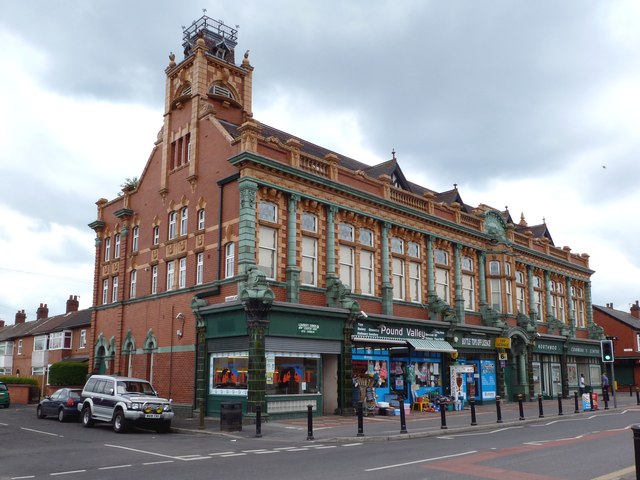
The old co-op building on Northmoor Road in Longsight, Manchester M12 5RT is an impressive building. Enough to be classed as a Grade II Listed Building in 1994. The other week it celebrated its centenary, only a few months late as the date on the building states 1912.

It was built for the Beswick Co-operative Society, founded in 1892, and a thorn in the trading area of the Manchester & Salford Equitable. The Beswick ignored any territorial agreements and would open branches were they felt they could do business. Thus districts like Levenshulme, Ancoats, Withington and Didsbury would have rival co-op stores.

Northmoor Road, originally called North Road was developed between 1899 thru to the 1930's. The most famous person to reside there was J.R.Tolkien between 1926-1947. We don't know if he went to the co-op for his tea and biscuits between writing another page of The Hobbit or Lord of The Rings.

Beswick Co-op building
The building rises up to two floors plus attic rooms in a square tower. It used to have a meeting room used as ballroom for dances to live music. The property is now owned by Great Places Housing Group who provide affordable, social and supported housing across the north west and Yorkshire.​​​​​​​​​​​​​ There is now a community centre and small business units on the ground flour. Apartments are on the upper levels. It's not every building that has a party by local residents to celebrate its 100th birthday. It was reported in the local newspaper, "the co-operative building is loved by all in the area, and that showed with the amount of local residents who came to the event." - South Manchester Reporter 25th April 2013.

There is no doubt a lot of history to this building, it is something I must follow up someday.
Further reading : Northmoor Road (Wikipedia)
Description of the architectural features
(Images of England)

Photo credit to www.geograph.org.uk

Wednesday, December 26, 2012

Norwest in Green and Yellow

Norwest Co-op report
Found this old Directors' Report from 1987 whilst rummaging through a pile of old papers. Why do we keep this old stuff? Things get put away and dumped into a junk room. Mine is a veritable trove of old ephemera, uncatalogued and piled in boxes.

Notice the green and yellow colour which was adopted by the Norwest Co-Op Society. The photograph doesn't do the yellow any favours it is really a strong canary yellow on paper. There is a list of all the members' half yearly meetings and there are 14 of them. There was one at Hardy Lane on Wednesday 21st October 1987 at 7.30pm and three others elsewhere on the same night. The Directors' and the people on the Members Relations Committee had to spread themselves across Greater Manchester over four different nights.

In the Member Relations Committee report the Woodcraft Folk, and the Norwest Co-Op New Mills Band are doing well. That band is still going after 200 years which is some achievement and have published some of their history in a book and still has The Co-Operative as a sponsor....website. However the demise of the Stretford branch of the Co-Operative Women's Guild was reported due to a decline in membership.

Turnover was over 77 million GBP, an increase of 630 thousand. Now I've kept this old bit of paper it would be a shame to throw it away. Or would it?

Thursday, September 27, 2012

Co-operative Graphic Novel

As it is International Year of Co-operatives a graphic novel has been, or is about to be released with the title being "The Co-operative Revolution". I've just acquired it, so am still reading it. The thing with graphic novels is you want to dwell over the pages and take in the artwork. Try to spot any quirky little doodles in the frames. "This graphic novel from master artist Polyp illustrates the history and enduring appeal of the co-operative movement" says the press release. It does.
It has four chapters - Yesterday, Today, Always and Tomorrow. Plus you get a potted timeline of events at the end. What you need to know - it starts with the Rochdale Pioneers, it goes into spaceships to Mars. It has 80 pages in colour. Full price £5.99. Published by New Internationalist on behalf of The Co-operative Group. It's the work of Polyp, a charming and amusing chap with a distinctive drawing style. He lives in Manchester. I'm going to enjoy finishing it, just need to make some quiet reading time.


ISBN is 978178026082. More Info here.

Friday, September 14, 2012

First M&SE Co-op Premises

M&S Co-op 1859 & 1909 Got lots of photos in the archive, and it's about time some of them were published. The first premises of the Manchester & Salford Equitable Co-op were rented at 168 Great Ancoats Street in Manchester in 1859. That's the little building shown as an inset.

The bigger premises are the Central Stores and Head Office on Downing Street, Ardwick and opened in 1864. Obviously the photographs were not snapped in those years, and probably date from around 1909 when the Society celebrated 50 years.

Here's a note about how the meaning of language changes. If you lived in Manchester in the years before the 1960's then M&S would refer to the Manchester & Salford and not Marks & Spencer. That famous company was often referred to as Marks & Sparks. Downing Street would mean the road in Ardwick. It was not used in the media to mean the home of the Prime Minister. They would make reference simply to No.10.

Sunday, September 9, 2012

Early Co-operatives Ancoats

Alright it's not Chorlton, we're still in Ancoats in the 1860's which is where the M&SE Co-op Society opened in 1859. Seventy years of expansion later they reached Hardy Lane.

Classified adverts in 19th Century newspapers are full of property transactions and from these you find parcels of land up for sale and how much rent was payable. By order of the trustees under the will of the late James Thompson four lots of property in Salford, Ardwick and Ancoats in Manchester went up for auction in May 1862. One lot took my eye as there was a co-operative store on the land. Also the Indigo Street Independent Chapel, schoolroom, butchers, the Royal Hen & Chickens Brewery and twenty five cottages.  Cottages is describing back to back one up one down small terrace houses. All packed into 1,750 square yards with the River Medlock as the northern boundary. If the census was checked we could find how many souls resided in this block.

It is a small area. A mere 20 per cent of a football pitch, about two penalty areas and the semi-circle in front of it. I've seen plenty of football pitches so have this area of land fixed in my mind - Old Trafford is 1.82 acres and City's pitch 1.84 acres. This plot of land is 0.36 acres. I doubt if there was a tree, garden or blade of grass in sight.

But what was the co-operative store? It wasn't the Equitable Society, and I think it is the Industrial Society. "The society commenced operations on a small scale in 1856, in Bridge Street" - report by Mr. H. R. Bayley the Secretary, at the 7th annual tea party of the Industrial Society at the Free Trade Hall. Can't be sure which Bridge Street in Manchester that was, there were several before streets were renamed in the 1960's to stop confusion with postal addresses. He goes on to say "another store had been erected in Stockport Road during the last year at a cost of £1,020. " - Manchester Courier Wednesday 1st February 1865.

"There was an earlier Manchester and Salford Industrial Society before 1859. It had a shop at 519, Ashton Old Road, Openshaw, and one in Ardwick, with a stone beehive over the door. The beehive was still there in 1878, but over a toffee shop." George Jacob Holyoake in his "History of Co-operation" Chapter 16.

Still can't be absolutely certain. Yet all this is typical of the start of modern consumer co-operation, that began with the Rochdale Pioneers in 1844. On grimy back streets, in sooty industrial cities. All this area has been swept away in slum clearance, the Mancunian Way was built nearby and a small industrial estate put in place.

Photo of Indigo Street, Gable of No. 18, m11739 taken in 1901 courtesey of Manchester City Libraries Image Collection.

Earlier post on Manchester & Salford Industrial Co-op Society - here.

Wednesday, September 5, 2012

Early Manchester Co-operatives


What could have been on the mind of those co-operators starting with a shop on Great Ancoats Street back in 1859 was the number previous ventures in collective enterprise that had struggled in their trading.

We know about these early co-operative stores through the writings of J.M. Ludlow (John Malcolm) who made a tour of Lancashire and Yorkshire in 1850. He was a barrister in London and a central figure in the Christian Socialists. These chaps were inspired by the co-operative producers in France and the Chartists and the most noted of them was Charles Kingsley, who wrote under the pen name of Parson's Lot and became famous with a books called "The Water Babies" and "Alton Locke".

Though J.M.Ludlow favoured producer co-operatives over consumer co-operatives his reports tracked down several Societies retailing in Manchester and Salford. G.D.H. Cole writing "The Century of Co-operation" in 1944 is a touch scathing about him thinking co-operative principles were in a few people making hats together rather than members owning shops and paying dividend.
  • Jersey Street Co-Operative Society, three stores and a bakery in Ancoats.
  • Garrett Road Industrial, a co-operative store in Miles Platting
  • Hudson Street, Salford, a co-operative store
  • Harpurhey, a new co-op society
  • Dyers' Trade Union, two stores, though he disapproved, holding them devoid of true co-operative principles
  • Central Co-operative Agency, a branch at 13 Swan Street.
  • Garden Lane, Salford, a co-op store and manufacturing with looms for some of its members.
There were others. The historian today trawls through online digitized newspapers looking for entries and finds a Chartist Co-operative Store in Hulme, or a case of embezzlement at the Flixton Co-operative and that's a small village west of Manchester near the River Irwell. The young Ludlow would be making enquiries in the terraced house districts of industrial Manchester for a small business run on co-operative principles.

In 1851 there was a Co-operative Conference in Bury in the April with 44 north of England co-ops attending, with 80 delegates, most of them from stores rather than workshops. Later in September there was a meeting of Associative Labour in Manchester with trade unionists, co-operators and sympathisers. The Rochdale Pioneers attended both meetings.

Small organisations only get their history written about if they survive long enough and grow big enough. Who knows anything about the Manchester Equitable Pioneers Co-operative attending the Bury conference? What happened to the Jersey Street Co-operative? Then the oldest in Manchester said their delegate Mr. Knight. "It started by offering 10s. shares (50p) with about 80 or 90 taken up. A capital of £400 and business of £120 weekly."

The success of the Manchester & Salford Equitable Co-op wasn't assured when they started in 1859 but would have learnt that lack of capital and not attracting members would mean ultimate demise.

Photograph courtsey of Manchester Libraries Image Collection. It is Jersey Street in 1967, m10166, and looks like it hadn't changed since the start of the century. Don't know which building on Jersey Street was occupied by a co-operative store.

Saturday, September 1, 2012

Industrial

A long time ago there were two co-operative societies in Manchester - the Equitable that eventually came to Chorlton and Hardy Lane, and the Industrial. Whilst the Equitable went onto greater trading the Industrial went into liquidation.....

"The Society was voluntarily wound up and liquidators appointed in September 1870 following meetings of the members at their offices in Upper Medlock Street, Hulme. "
London Gazette 8th October 1870; page 4358


The Industrial was centered in Hulme, a working class district south of the centre of Manchester. In the 1840's it was fields. When Augustus Pugin built a church here 1845 with the Earl of Shrewbury's money, it was known as St. Wilfred's-in-the-fields. Ten years later it is surrounded by dense housing and thousands of inhabitants.

The Industrial started in a small way in 1856, and became an Industrial & Provident Society in 1859 with a capital of just £13, sales of £2,045 and 28 members. Humble and hopeful beginnings that grew to six grocery branches, two draperies and two butchers in 1864. Membership was then around 1,274 and sales were £27,442. Central Stores were on Upper Medlock Street, Hulme. I've been trying to piece together their history from newspaper reports of the annual meetings. Besides speeches from the Mayor of Manchester, and Ernest Jones the noted Chartist, the meetings ended with two hours of dancing. No mention of any alcohol so they might have been 'dry' occasions.

It will take some time to solve why the finances came crashing down. There maybe a clue in a court case at the Manchester County Court : Walker v. M&S Industrial Co-op Society on Wednesday 13th April 1870.  Dr. Richard Pankhurst represented the Society. Much later he married Emmeline Pankhurst, yes the famous suffragette, but she'd only be a 11 year old lass in Moss Side when this case was heard. The plaintiff thought he'd lent money for interest to the society and wanted it back. The society said he was a member and no withdrawals could be made because many other requests were being made to withdraw capital. The case was lost when the judge ruled there was insufficient documentation for him to be a shareholder.

Sales did decline and membership shrunk in 1869, the last year of reported finances...maybe it continued. I'm sure further digging will reveal more and maybe a relevant photograph.

Was there rivalry between the Equitable and the Industrial? Well both operated in different parts of Manchester and the directors of both societies attended each others annual meetings. "Though there might be emulation, there was no opposition; that there was rivalry, but it was devoid of ill-feeling" said the Chairman at the 7th annual soiree as reported by the Manchester Courier and Lancashire General Advertiser Wednesday 1st February 1865.
The picture above is m77988, courtesy of Manchester Libraries Image Collection and is of Wooden Bridge Street, Hulme in 1909,  Chosen because it has an atmospheric quality.

Saturday, July 28, 2012

Technical Bread

bread-at-technology
Now this is just some photograph that I happened to spot in a 1909 co-op magazine, the Manchester & Salford Herald, whilst researching something else. Well 1909 was the 50th year of the Manchester & Salford Equitable Co-Op Society so there would a jubilee history published that year. So I didn't take any details of why these bakers from the M&S are posing for the photographer in the Municipal Technical College.

I'm presuming this is the college that became UMIST, and now is integrated into Manchester University. For all I know that room with white brickwork might still exist it one of the older buildings on Whitworth Street. What a fine display of craft baking buns, cobs and bloomers. The large round loaves that break into four farls look particularly good.

It's not possible to say if this was a typical bread offer at the time. It is a demonstration of skill. The co-op societies always stressed their hygienic methods and unadulterated bread. Those bad practices bedevilled the working classes from obtaining a proper loaf throughout the 19th Century. Twenty odd year later this would probably look quaint as the sliced bread revolution swept the USA and came to Britain shortly afterwards.

Notice that there is no baton shaped bread. Can't remember when the staple shape of French bread made its appearance in the supermarkets. Definitely in the early 1980's in Chorlton.

There is a good article in The Atlantic magazine : "The Best Thing Since Sliced Bread: A Brief History of Sliced Bread. Has some good pictures including an illustration of the 1928 patent for the slicing machine.

Thursday, June 21, 2012

Co-Operate App

Essentially find a co-operative nearby with your mobile device. Yes, I downloaded it, and yes it came up lots of co-operatives in the vicinity and beyond. Just as it says in the write-up.

"Co-operate makes it easy for people to find co-operatives and mutuals across the UK. Whether they need food or phones, electricity or banking, Co-operate allows customers to download a better world on to their mobile phone."

Being a big fan of information at the fingertips this sort of thing appeals to me. Available for iPhone and Android and it is free. Hope the information will be kept up to date.
Details here.

Thursday, June 14, 2012

Local Members Meeting

Co-op Meetings 1987
Just to prove there were Members Meetings at Hardy Lane I found a notice in a Norwest Co-Op magazine from 1987. I might even been to it. We used to drift along to take a seat. Immediately the big concern was would the meeting be quorate. Can't remember what the quorum was but it might have been twenty members. Failure to obtain a quorum could result in the hall upstairs being removed from the schedule next time around.

At the top table would be the men and women from the various committees. You'd get a finance report which could either be brief and informative, or tedious references for you to look at the figures on page 23, page 29, page 36 & etc.

Then came the voting by either a show of a card, or a secret ballot into a sealed black box. All above board democratic stuff. Even at the time they were not very memorable but there used to be a sprinkling of older members who no doubt had been trooping down here for thirty odd years. Most of the others were involved with Woodcraft Folk who wanted repairs or a new coat of paint for the Hardy Lane Co-Operative Hall. I think there was a free raffle, and it was a prize of groceries or a voucher which made it a good evening when you won.

Thursday, May 31, 2012

New Deansgate House Co-Operative Emporium

New Deansgate House
A little diversion into the centre of Manchester. Prompted by a question posed underneath a photograph I uploaded to Flickr. Where was Deansgate House? So a little story about New Deansgate House, a co-operative venture about few buildings north of the famous Kendal Milne building. It was at 84 Deansgate, Manchester.

The building is still there, and it's an architectural gem if you haven't set your head against the modernist style.

Though Manchester was the headquarters of the co-operative movement it never had a department store in the city centre. In 1945 six local co-operative societies and the wholesale society formed the Co-Operative Emporium Limited. Beswick, Blackley, Failsworth, Manchester & Salford, Pendleton, and Prestwich joined with the CWS. The following year the CWS acquired the Deansgate Arcade. One of the those fine Victorian versions of shopping under one roof with small upmarket shops fronting a passageway that ran from Deansgate to Parsonage Gardens. There are some fine examples in Leeds.

But it wasn't until 1955 that last tenants left and the old building was demolished for a bright vision of the future.The architect was George S. Hay of the CWS. He later went to design with Gordon Tait the prestigious CIS Tower & New Century House on Miller Street opened in 1962.

New Deansgate House
Essentially New Century House is a steel frame constructed by Edward Wood & Co at the Ocean Ironworks in Trafford Park and lots of glass was put around it. This was new for Manchester. The cost is reported as £500,000. It opened on the first day of spring, that'll be Saturday 21st March 1958 by  Leonard Cooke the chairman of Co-Operative Emporium Ltd.

A whole five floors, no food department, but furnishings, fashion, gramophone records, and a cafteria. The Co-Op Bank then a small banking operation of the CWS with no branches opened its first mini bank here on Monday 20th October 1969. An early example of in-store franchise.

But the venture was not a massive success that the co-operative hoped and planned for. Whatever the reasons for its slow decline - wrong stock, unfashionable image or prices - I will have to investigate.

There is a lot to discover and the Co-operative Emporium Limited archives are kept at the Greater Manchester Records Office. The company ceased and was de-listed as an IPS in July 1973. At least we still have the building which is a miracle for a city that is always being re-built.

Thursday, May 24, 2012

Pioneers Museum

The Rochdale Pioneers Museum opens soon. Refurbed with a visitor centre on the empty plot next door. That comes to 2.3 million GBP in building work. Well if you've come all the way from abroad it would be good to see more than two floors of tiny store.

It was used by the Pioneers as their shop from that historic date on 21st December 1844 until sometime in 1867 when they moved to their new Central Stores up the road. Fortunately for the history of co-operation the building was bought by the Co-Operative Union in 1925 thus saving it from redvelopement. The museum opened with due ceremony on Saturday 11th April 1931. Even then it was talked about as a place of pilgrimage for co-operators from all over the world.


We visited years ago so well overdue another visit to Rochdale. When the the new tram to Rochdale opens in 2014 it will be possible to go from Hardy Lane to the Museum on this modern transport system. Changing at Victoria and maybe a walk involved. But we're not waiting until then we'll be up there next month.

The new website is in place, still a few bits missing, but a vast improvement on the previous. Link.
Illustration dates from M&SE Herald 1909.


Monday, May 21, 2012

Windows to a new world

 By chance I came across some interesting display advertisements from 1950. They are line drawings for this is when photographic reproduction in newspapers was limited and so everything from cars, fridges and bread was by illustration. They are interesting because they are by Richard Hilder (1905-1993) a great painter, especially of landscapes. He also a top illustrator, the chap who produced those classics of the countryside for the Shell Oil Company in the 1930's. The open road, speed and the slogan "That's Shell -That Was!" 'cos the car is in the distant of the spectacular scenery.

So far I've found thirteen low-fidelity reproductions for a series entitled "Windows To A New World". It would be good to obtain better reproductions and let them be seen by a wider audience.

The Rochdale Equitable Pioneers store on Toad Lane is one of them. That looks like the Central Stores of the Society in the background and I don't think that building exists anymore. Fortunately some had the foresight to save the old store otherwise it would just be a blue plaque on the side of a car park. Another is the E&S CWS Tea Warehouse on the Manchester Ship Canal. It was opposite the Pomona Docks on the Salford side. That has been demolished and the docks too.

Others in the series include the Bradford Co-Op Emporium a wonderful art deco building, the CWS Flour Mill at the Royal Victoria Dock in London, a mobile shop in Penrith, and Co-op Tullygoonigan Creamery in Northern Ireland. It's like a Pevsner guide of 1950's Britain.

Each advert extols the virtues of the CWS production and gives a little bit of history. "The CWS produces in its own 194 factories almost every other commodity needed in the home. Britain's biggest business, it helps more than 10,000,000 Co-op members cut their cost of living."


Well the factories have gone but at least we still have a museum and it re-opens soon.

For some better versions with more detail see the same advertisements in Lilliput magazine from the same time. A couple of good posts on Visual Rants, which gives more information about these drawings.


Monday, May 14, 2012

Membership still a quid

Join the Co-OpJoin the Co-Op
It costs just £1 (1 GBP) to join a consumer co-op. Unchanged for nearly 170 years. By today's values the original 28 Rochdale Pioneers (1844), or the 100 members to form the Manchester & Salford Equitable (1859) would have had to find £78 (78 GBP) to join their Society. Joining in 1929, when the Hardy Lane Co-Op store opened, the cost in today's money would be a little over £49 (49 GBP).

Then, as now the money can be withdrawn. Well it used to be but I've not checked recently. It also entitled you to a dividend on purchases. The M&SE in its early years also used to pay a dividend to non-members but at half the rate of members.

In the photographs is the application form to join the Norwest Co-Operative from around the mid-1980's. There was no dividend after the dividend stamps scheme ceased. The value of £1 then is equivalent to £2.37 in 2012.

You can join The Co-Operative online and you don't even have to send off £1 for it is deducted from your first dividend.

Sunday, April 22, 2012

Origins of M&S


The story of a meeting by the young men of the Roby Brotherhood on Christmas Day 1858 is given as the start of the Manchester & Salford Equitable Co-operative. I quite like this artists impression of one of their meeting made 100 years later. But deep down you know it paints a myth of how it was.

The chaps were mostly in their late twenties and early thirties. Working men, young dads, who attended the Roby Chapel, a noted Congregationalist Church and Sunday School in Manchester founded by William Roby. They would have worked six days a week, so a Saturday off work for Christmas Day would have been most welcome. Though they would have lost a days wages. They met at a small house at 22 Pump Street, Manchester set amongst  mills, workshops and ironworks. Across London Road would have been a new railway station for Manchester (the one now called Piccadilly). Pump Street and most of this area was redeveloped at the start of the 20th Century when Whitworth Street and grander buildings were constructed. The old fire station was built on the site of Pump Street.

If you've ever organised a meeting then you'll know the getting enough seating is the first priority. You couldn't imagine a long table and lots of matching chairs like some upper middle class dinner party. Well not in small terraced abode on narrow cobbled street. The room would have been packed.

Anyway they decided to form a co-operative on the lines of the Pioneers of Rochdale who had already been successfully trading for 15 years. They would rent a shop and when they had raised £100 and had 100 members it would open. Six months later that plan came to fruition. On the 4th June 1859 the shop opened at 168 Great Ancoats Street.

Saturday, April 14, 2012

WCML Visit

Jubilee Herald 100 years
Made an appointed visit to the Working Class Movement Library at 51 The Crescent in Salford. Have this journey well organised now. Tram from Chorlton to Deansgate, cross the bridge to the rail station, then catch a train just one stop to Salford Crescent. Coming back took train to Manchester Victoria, cross over to the tram to Chorlton. Not bad for a £3.20 rail zone one ticket.

The stuff I wanted to look at was waiting on the table. They have a lot more than they mention in the online catalogue. Browsed away for a couple of hours, snapping away with the camera instead of making copious notes.

Best bit was a centenary issue of the Herald magazine of the M&SE Co-Op published in 1959. Though I've concentrated on the Manchester & Salford because it is more interesting and further back in time the fact is the Hardy Lane store has been operated for longer under successor  societies. Norwest Co-Op took over in 1970 when the M&SE merged with the Pennine society and the Stockport society. Further mergers brought the Norwest Pioneers, United Norwest, then United and finally The Co-Operative.

Friday, April 13, 2012

Old Delivery Bike

This old bicycle has seen better days. A lot of us will remember them. Sturdy, heavy, no gears, and rod lever brakes. Tough work for hills and into the wind. Now just collectors items, museum pieces or a prop for a costume drama. Personally I'd like one but in working order. The postman / postwoman's bicycle delivery bike has recently been phased out.

Will delivery bicycles make a come-back? Just like the way trams returned to our streets after 40 odd years.

Tuesday, April 10, 2012

Since 1859

Scotmid Carrier BagI was visiting Edinburgh only last weekend, and chanced to make a few purchases at a local Co-Op store. Obviously spotted the wording on the carrier bag "at the heart of Scottish communities since 1859". Scotmid didn't operate until 1981, and the 1859 is the year of formation of St.Cuthbert's Co-operative Association. The rule is you always pick the date of the oldest Society in any amalgamation. 1859 is the same year as the formation of the Manchester & Salford Equitable Co-op.

The M&SE started when they had 100 members and over £100 in capital, St.Cuthbert's opened with only 63 members and only £30 capital. It took many years for it to grow into a thriving Society.

One interesting fact about St.Cuthbert's is "the directors were, for twenty-two years, not in any way selected, but were simply taken from the roll of members. The names were called out at a quarterly meeting, and the person called upon could either accept or decline office as he thought proper....not until 1881 when capital was nearly £10,000 and the annual sales reached £30,000 did the members choose whom they thought best qualified for the office."

St.Cuthbert's made the last horse drawn deliveries of milk in 1985. This and some other history is in a timeline is at the Scotmid website.

Scotmid 150 years
The quote above is from a footnote in The Consumers' Co-operative Movement by Sydney and Beatrice Webb, 1921, who reference First Fifty Years of St.Cuthbert's Co-operative Association edited by William Maxwell, 1909. The Webb's book is out of print and I use a battered 1930 edition but it is available online at Archive.Org

Friday, April 6, 2012

The Herald


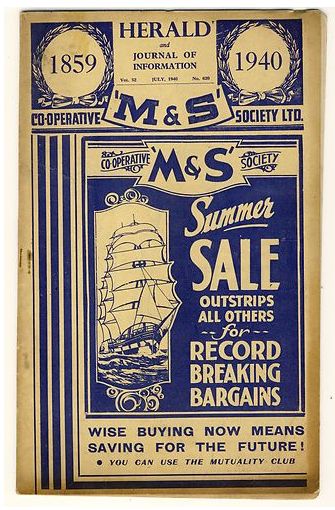
The source of much information about the Manchester & Salford Equitable Co-operative was the monthly publication, given away free in the stores. These are three covers from 1940 and as you'd expect have the patriotic tone of wartime. You could spend a small fortune bidding for co-operative memorabilia on that e-bay.

The nearest I've come to a complete collection 1889 - 1960 in slim bound volumes is at the National Co-operative Archives in Manchester. But even they are missing a few.

Other Societies issued similar monthly magazines, and those that didn't often gave away a CWS publication called Wheatsheaf that had local news section.

Friday, March 23, 2012

150 years in 2013

Co-operation can always celebrate an anniversary, and 2013 will be the 150th Anniversary of The Co-Operative, or as it used to be known the Co-Operative Wholesale Society dating from the 10th October 1863 in Manchester.

Work is already under way by some professional historians at Universities in Liverpool to produce a book. Another book? Well as they point out in this initial article co-operation has been ignored for too long in the media, and in the school curriculum....

Link - you can also download a PDF from here.
You can email : coop AT biffadigital.org with any information that will help in the making of this history.