Situated in a suburb of Manchester, England this is a story of a co-op store still with meeting rooms above the shop, and the lane itself. Plus other related or not so related history.
Showing posts with label Manchester. Show all posts
Thursday, December 20, 2012
Wartime bomb maps
The local Tv news recently reported that the maps of where the bombs fell on Manchester during WWII are now available online. There is hardly a day when there isn't a story about the war and those who lived through it, and never a day when some Tv channel isn't showing a drama or documentary about that conflict. However this was now new information readily accessible for everyone. It was a revelation especially when you discover a fire bomb fell in front of your own house, or a high explosive bomb landed on the next plot on the allotments up the road. It accounts for why we have hideous cheap post-war buildings in streets of fine old properties. For example Chorlton Post Office a construction of no merit that replaced a Victorian building that was destroyed by enemy action.
The whole of the city is divided up into various pages, and an hour has gone by before you realise you've just been staring at red (incendiary bombs) and blue (high explosives) markings on 80 year old Ordnance Survey maps. The maps also reveal how much of Chorlton was still fields and how many allotment gardens and tennis courts there were.
To keep it relevant to the weblog the picture is of the corner of Hardy Lane, Mauldeth Road West and Barlow Moor Road had shews where an explosive device fell on the 12th March 1940 and exactly a year later several more nearby. Both dates outside the heavy blitz on Manchester 22nd and 23rd December 1940.
Links:
Wartime Bomb Maps of Manchester.
Further stories of wartime bomb damage at Chorlton History......
Monday, July 30, 2012
Major Emporiums 1959
The illustration shews the Manchester & Salford Equitable Co-op major stores, that is they sold clothes and household goods besides food. It dates from 1959, the centenary of the Society. Hardy Lane doesn't feature for it is only a food store.
All this has now gone. The Co-Operative still has food stores in some of those locations, some in different buildings - Burnage, Knutsford, Stretford Gorse Hill, and Didsbury Village. The headquarters is now an industrial estate. The mobile shops long ceased travelling the south Manchester estates, the milk deliveries stopped possibly as late as the 1990's. The railway line running north-south to the left is now a successful metro tram service. The other railway line north-south right side now takes you to Manchester Airport.
I was checking an old telephone directory from 1959 and it listed seven M&SE shops with a Chorlton number. The prefix was CHO, nearby Stretford was LON presumably for Longford as in the big park in the that town. It could have been used in London but wasn't.
Here is the list :
Funerals 347 Barlow Moor Road CHO 4138, still trading next to Hardy Lane store.
Coal Sidings, Albany Road CHO 4947 - now a car park for Morrisons
Grocery & Drapery, 442 Barlow Moor Road - now a computer games shop and a bookmakers
Grocery, 14 Milton Grove CHO 1052 - now a driving test centre
Grocery & Butchers, 66 Beech Road CHO 1053 - now a gift shop and a restaurant
Grocery, 90 Warwick Road South CHO 1809 - now an independent convenience store
Grocery & Butchers, 349-351 Barlow Moor Road CHO 2115 - the Hardy Lane store
I always thought the coal sidings were private coal merchants but the local co-op had coal delivered there too. The picture of those sidings is from 1960 and is being used for other goods too. What was delivered in all those drums? Courtesy of Manchester City Libraries (number M18314) and their brilliant collection of archive online images. The illustration is from Manchester & Salford Co-operative Herald Jubilee Souvenir 1959.
Saturday, July 28, 2012
Technical Bread
Now this is just some photograph that I happened to spot in a 1909 co-op magazine, the Manchester & Salford Herald, whilst researching something else. Well 1909 was the 50th year of the Manchester & Salford Equitable Co-Op Society so there would a jubilee history published that year. So I didn't take any details of why these bakers from the M&S are posing for the photographer in the Municipal Technical College.
I'm presuming this is the college that became UMIST, and now is integrated into Manchester University. For all I know that room with white brickwork might still exist it one of the older buildings on Whitworth Street. What a fine display of craft baking buns, cobs and bloomers. The large round loaves that break into four farls look particularly good.
It's not possible to say if this was a typical bread offer at the time. It is a demonstration of skill. The co-op societies always stressed their hygienic methods and unadulterated bread. Those bad practices bedevilled the working classes from obtaining a proper loaf throughout the 19th Century. Twenty odd year later this would probably look quaint as the sliced bread revolution swept the USA and came to Britain shortly afterwards.
Notice that there is no baton shaped bread. Can't remember when the staple shape of French bread made its appearance in the supermarkets. Definitely in the early 1980's in Chorlton.
There is a good article in The Atlantic magazine : "The Best Thing Since Sliced Bread: A Brief History of Sliced Bread. Has some good pictures including an illustration of the 1928 patent for the slicing machine.
Thursday, May 31, 2012
New Deansgate House Co-Operative Emporium
A little diversion into the centre of Manchester. Prompted by a question posed underneath a photograph I uploaded to Flickr. Where was Deansgate House? So a little story about New Deansgate House, a co-operative venture about few buildings north of the famous Kendal Milne building. It was at 84 Deansgate, Manchester.
The building is still there, and it's an architectural gem if you haven't set your head against the modernist style.
Though Manchester was the headquarters of the co-operative movement it never had a department store in the city centre. In 1945 six local co-operative societies and the wholesale society formed the Co-Operative Emporium Limited. Beswick, Blackley, Failsworth, Manchester & Salford, Pendleton, and Prestwich joined with the CWS. The following year the CWS acquired the Deansgate Arcade. One of the those fine Victorian versions of shopping under one roof with small upmarket shops fronting a passageway that ran from Deansgate to Parsonage Gardens. There are some fine examples in Leeds.
But it wasn't until 1955 that last tenants left and the old building was demolished for a bright vision of the future.The architect was George S. Hay of the CWS. He later went to design with Gordon Tait the prestigious CIS Tower & New Century House on Miller Street opened in 1962.
Essentially New Century House is a steel frame constructed by Edward Wood & Co at the Ocean Ironworks in Trafford Park and lots of glass was put around it. This was new for Manchester. The cost is reported as £500,000. It opened on the first day of spring, that'll be Saturday 21st March 1958 by Leonard Cooke the chairman of Co-Operative Emporium Ltd.
A whole five floors, no food department, but furnishings, fashion, gramophone records, and a cafteria. The Co-Op Bank then a small banking operation of the CWS with no branches opened its first mini bank here on Monday 20th October 1969. An early example of in-store franchise.
But the venture was not a massive success that the co-operative hoped and planned for. Whatever the reasons for its slow decline - wrong stock, unfashionable image or prices - I will have to investigate.
There is a lot to discover and the Co-operative Emporium Limited archives are kept at the Greater Manchester Records Office. The company ceased and was de-listed as an IPS in July 1973. At least we still have the building which is a miracle for a city that is always being re-built.
Sunday, May 27, 2012
Back to the Railway Arch
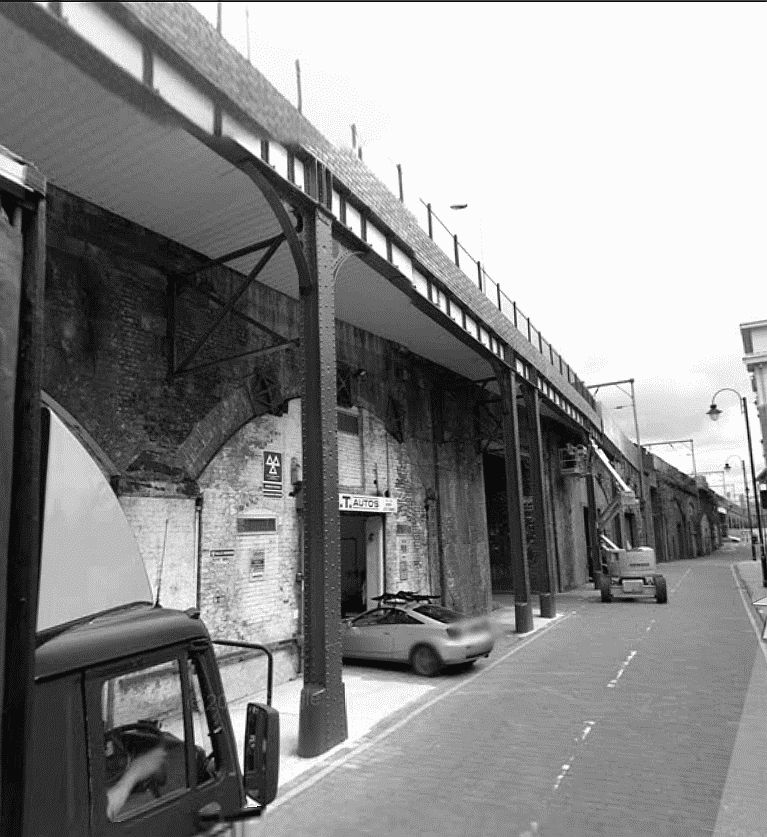
Underneath this arch there was a conference to form the CWS that met on a snowy Christmas Day in 1860. The story is in a previous post. The arches are there, the temperance hall in one of them has been replaced by a motor repair business. There is no blue plaque that highlights the event. The other places where other conferences were held to form a wholesale society have been demolished. The public hall in Ancoats, and the Jumbo Farm in Middleton.
What you are looking at is Hewitt Street, Manchester with a railway viaduct between Oxford Road Station and Deansgate Station. Should you ever be meandering up there the arch is just before Rowendale Street (used to be called Rowe Street) as you walk eastwards towards City Road. Top photograph is from "The story of the C.W.S.; the jubilee history of the Co-operative Wholesale Society Limited, 1863-1913" by Percy Redfern and dates from around 1912. It is available at the Archives.Org
Saturday, May 26, 2012
Under the Railway Arch
There was a meeting to form a co-operative wholesale society in a railway arch. I don't think any of the 50 or 60 delegates had top hats though, as illustrated here. Definitely not the attire for a working man. Muddy marshes of the Irwell river - had they never seen the brown-grey depressing trench of water that snakes its way tp fprm a boundary to the city. Oh how they stylise history back then 60 years ago and today.
The arch is on Hewlitt Street, Manchester under the railway line between Oxford Road and Deansgate. Built in 1849 as the Altrincham & South Junction Railway. Back then it was a temperance hall warmed with a smokey stove, and probably lit by oil lamps. In the 1870 street directory 89 Hewlitt Street was occupied by the British Workman Total Abstinence Society, but another organisation may have been there in 1860. There were plenty of temperance societies in Manchester in those times. Plenty of pubs doing a good trade too.
"It was a heroic way to spend Christmas. The conference was called for two o'clock and six o'clock pm on a day when trains ran as on Sundays, and at a period when a third class railway journey from Manchester to Halifax occupied at least three or four hours".
Sources : CWS Display Advert 1951. Quote from "The story of the C.W.S.; the jubilee history of the Co-operative Wholesale Society Limited, 1863-1913" by Percy Redfern. It is available at the Archives.Org
The arch is on Hewlitt Street, Manchester under the railway line between Oxford Road and Deansgate. Built in 1849 as the Altrincham & South Junction Railway. Back then it was a temperance hall warmed with a smokey stove, and probably lit by oil lamps. In the 1870 street directory 89 Hewlitt Street was occupied by the British Workman Total Abstinence Society, but another organisation may have been there in 1860. There were plenty of temperance societies in Manchester in those times. Plenty of pubs doing a good trade too.
"It was a heroic way to spend Christmas. The conference was called for two o'clock and six o'clock pm on a day when trains ran as on Sundays, and at a period when a third class railway journey from Manchester to Halifax occupied at least three or four hours".
Sources : CWS Display Advert 1951. Quote from "The story of the C.W.S.; the jubilee history of the Co-operative Wholesale Society Limited, 1863-1913" by Percy Redfern. It is available at the Archives.Org
Thursday, May 10, 2012
Bread in a wrapper
Here we have the M&SE promoting their bread. I like the use of the word propaganda. This is 1929 and before the word became tainted by political and military conflicts of the dictatorships of Europe. But a cart clopping down the street with a pretend extra large loaf is hardly the dark forces of propaganda.
The term wrapped bread is stressed to promote the hygienic production and handling. This was a fairly new way of retailing by putting loaves in grease proof paper. The days of the unwrapped bread would be seen as old fashioned. Though people apparently survived for centuries and centuries by buying loaves not in paper.
However there was a further development just on the horizon. Sliced bread! Invented in the USA and the date usually quoted is 1928. The slicing machines had been developed a lot earlier it was holding the slices together in suitable packaging that was needed.
One of the pioneers in marketing sliced bread in Britain was R.Sharrock & Sons here in Manchester. They had bakeries, or scientific plants as they called them, in Chorlton-on-Medlock and they introduced the "Tip Top" loaf. You got 22 even slices in a 2lb loaf. Their display adverts gave instructions. "The Tip Top wrapper opens at the end, the loaf is boxed in a tray, which has been hygienically treated. The tray slides out and you simply take the number of slices required - push the tray back and tuck in the ends." All this for 4½d. The rest you know....it's the best thing since sliced bread.
Credits : M&SE Herald 1929. Display advert Manchester Guardian 29th April 1930
Tuesday, May 8, 2012
Arbitrators 1859
When the Manchester & Salford Equitable Co-Operative was founded in 1859 they appointed a body of men called arbitrators. Don't know if they ever did any arbitration. But they were invited to the members' meetings and would have lent patronage to a newly founded commercial venture. Interesting five names from radical, non-conformist chapels all well known to the members of the Manchester and Salford co-operators. We are reading articulate middle class, mostly teetotal and vegetarians. They have an interest in democratic reform, free libraries and improvements for the working classes. Then there is Abel Heywood who was buried in the grounds of his home and has his statue in Albert Square.....

Samuel Pope, barrister, aged 33. Secretary of the UK Alliance for the Suppression of the Traffic in all Intoxicating Liquors. This was a prohibitionist organisation and he stood on this ticket for Stoke 1857 and as Liberal in Bolton in 1859. Didn't win but was re-elected Councillor for Seedley Ward, Salford in November 1859. Henry Dow, one of the instigators of the "Maine Law" which made that state dry (alcohol banned) visited England in April 1857. He greeted him on arrival in Liverpool.
Rev. Thomas Gardner Lee, pastor, aged 59. His church was the New Windsor Chapel (Congregationalist), Cross Lane, Salford. He'd been preaching there since 1843. Responsible for publishing the second edition of Henry 'Box' Brown's Narrative in 1851 It describes Mr. Brown's escape from slavery to Philadelphia in 1849 by being posted in a wooden crate. Supporter of the Union & Emancipation Society in Manchester, the anti-slavery campaign which had two local co-operators J.C.Edwards and Edward Owen Greening as Secretaries.
William Harvey, Mayor of Salford, aged 70. President of the Vegetarian Society, it started in Salford. Active in the Bible Christian Church, Salford. Founder member of UK Alliance for the Suppression of the Traffic in all Intoxicating Liquors, the first meeting was at his house in Acton Square, Salford. Vice President of the Anti-Tobacco Society. Campaigner for Parliamentary Reform.
Abel Heywood, publisher, bookseller and Mayor of Manchester. Aged 49, and best described as Mr. Manchester of the 19th Century. We know of his radical politics, a former Chartist and three convictions for defying the tax on knowledge - selling newspapers without stamp duty. More to come on Alderman Heywood and his support for co-operatives and connections with the M&SE Co-Op.
James Gaskill, aged 58, Bible Christian minister chapel at Queen Street, Hulme. Lived at 340 Stretford New Road. His occupation is listed as a Cotton Spinner, possibly a spinning business, but when elected to the Chorlton Board of Guardians he is described as a schoolmaster. Well he did this later with educational institutes set up by the Bible Christian Church. A director of the Manchester Mechanics' Institute. Also a teetotaler and vegetarian. Years earlier he presented a silver star and chain to Henry Anderton the teetotal poet in a ceremony in Manchester.
Thanks to Andrew Simpson at Chorltonhistory for help with this research. References to "A Guiltless Feast" by Derek Antrobus 1997 which is a good account of the Salford Bible Christian Church and the rise of the modern vegetarian movement.

Samuel Pope, barrister, aged 33. Secretary of the UK Alliance for the Suppression of the Traffic in all Intoxicating Liquors. This was a prohibitionist organisation and he stood on this ticket for Stoke 1857 and as Liberal in Bolton in 1859. Didn't win but was re-elected Councillor for Seedley Ward, Salford in November 1859. Henry Dow, one of the instigators of the "Maine Law" which made that state dry (alcohol banned) visited England in April 1857. He greeted him on arrival in Liverpool.
Rev. Thomas Gardner Lee, pastor, aged 59. His church was the New Windsor Chapel (Congregationalist), Cross Lane, Salford. He'd been preaching there since 1843. Responsible for publishing the second edition of Henry 'Box' Brown's Narrative in 1851 It describes Mr. Brown's escape from slavery to Philadelphia in 1849 by being posted in a wooden crate. Supporter of the Union & Emancipation Society in Manchester, the anti-slavery campaign which had two local co-operators J.C.Edwards and Edward Owen Greening as Secretaries.
William Harvey, Mayor of Salford, aged 70. President of the Vegetarian Society, it started in Salford. Active in the Bible Christian Church, Salford. Founder member of UK Alliance for the Suppression of the Traffic in all Intoxicating Liquors, the first meeting was at his house in Acton Square, Salford. Vice President of the Anti-Tobacco Society. Campaigner for Parliamentary Reform.
Abel Heywood, publisher, bookseller and Mayor of Manchester. Aged 49, and best described as Mr. Manchester of the 19th Century. We know of his radical politics, a former Chartist and three convictions for defying the tax on knowledge - selling newspapers without stamp duty. More to come on Alderman Heywood and his support for co-operatives and connections with the M&SE Co-Op.Thanks to Andrew Simpson at Chorltonhistory for help with this research. References to "A Guiltless Feast" by Derek Antrobus 1997 which is a good account of the Salford Bible Christian Church and the rise of the modern vegetarian movement.
Thursday, March 15, 2012
Civic Pride
Manchester Civic Week was 2nd - 9th October 1926. It featured a pageant through to Albert Square, concerts and you could visit factories in Trafford Park to see how products were produced. A full programme of pride and propaganda. The "Manchester Guardian" had a supplement and this is a colour advert from it.
This advert shows four co-operative societies that traded within the boundaries of the city - Manchester & Salford Equitable Co-operative Society, the Failsworth Industrial Society, Beswick Co-operative Society and the Blackley Co-operative Society. Just over the city limits would be the Prestwich, Eccles Provident, Pendleton, two Oldham societies, Bury, two Rochdale societies and etc.
Co-op Societies were fiercely independent, accountable to their local membership. The downside was they overlapped, and the Beswick opened stores in M&SE territory. Eventually the local strength proved to be a weakness when the multiples got their act together in the 1950's and had stores across the regions of England and with mergers and takeovers became national players.
There is all the symbolism of the sun's rays, a banner being hoisted by strong men above the Manchester coat of arms. The observant will notice that the ship only has two sails, currently it has three and in earlier 19th Century styles it came in full rigging of about 15 sales.
The quote is by George Jacob Holyoake and is a shortened version from which appears in his "The history of co-operation in England: its literature and its advocates" published in 1875.
There is some great silent newsreel footage shot of the parade into Albert Square, Manchester. Stealing the show is the visit by Sir Alan Cobham who was a celebrated air pioneer. Silent footage and copyright restricted but you can view it here.
Photo credits : Mickey Ashworth Flickr Photos
George Jacob Holyoake's book is in the Internet Archive. The quote is on page 5
Subscribe to:
Posts (Atom)
You can email : coop AT biffadigital.org with any information that will help in the making of this history.