Friday, April 13, 2012

Old Delivery Bike

This old bicycle has seen better days. A lot of us will remember them. Sturdy, heavy, no gears, and rod lever brakes. Tough work for hills and into the wind. Now just collectors items, museum pieces or a prop for a costume drama. Personally I'd like one but in working order. The postman / postwoman's bicycle delivery bike has recently been phased out.

Will delivery bicycles make a come-back? Just like the way trams returned to our streets after 40 odd years.

Thursday, April 12, 2012

Biscuits 1929


The advert is for CWS biscuits available back in the 1920's when this Co-Op store opened. I've no evidence that the CWS was an innovative biscuit maker but rather it took established popular types and produced them for their members, the retail Co-Op Societies.

Some of these varieties are still available though no longer manufactured in co-operative factories. The legendary Crumpsall Cream Cracker has passed into memory but the original Jacob's is still a national treasure. Ireland's contribution to snack culture dating from 1885.

Ginger Nut (circa 1840 and I have a recipe for them in a walnut shape from 1852), Petit Beurre (1886 in Nantes, France), Osborne (Huntley & Palmer 1860) and Marie (Peak Freans 1874) are still with us. Teatime exists as a variety pack these days. Fairy Cakes (circa 1796) have recently morphed into the larger size more sugary topped Cup Cakes. Just what the country didn't need, a lack of portion control to replicate American obesity levels.

But what about the Royal George and the Royal Princess? Royalty names for biscuits and confectionery has always been a good marketing feature. For last year's royal wedding special tins by McVities were sold in stores. Same for the President, the intriguing Trevenna or the mysterious Devon Finger? They might still exist under a different name. For example the Gypsy Cream so beloved of script writers and the writer Alan Bennett, which is now the more politically correct Romany Cream.

Now I'm taking a guess here that these are packet biscuits. The M&SE Co-Op also sold loose biscuits at 11d per pound (about 4.5p for 453.5 gms) in 1929. In an advert in the December issue of the M&S Co-operative Herald the following varieties are listed :- Ceylon, Coconut King, Water, Almond Nuts, and Playtime.

East West Home's Best biscuit tin is in an art deco style from the CWS circa 1930. Advert is from The People's Year Book 1926 published by the CWS Manchester and the SCWS Glasgow - a volume of specific information prepared by the Co-Operative Press Agency. An annual first published in 1918.

Tuesday, April 10, 2012

Since 1859

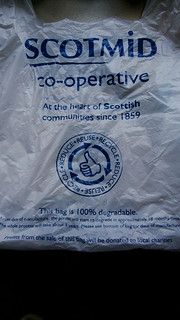
Scotmid Carrier BagI was visiting Edinburgh only last weekend, and chanced to make a few purchases at a local Co-Op store. Obviously spotted the wording on the carrier bag "at the heart of Scottish communities since 1859". Scotmid didn't operate until 1981, and the 1859 is the year of formation of St.Cuthbert's Co-operative Association. The rule is you always pick the date of the oldest Society in any amalgamation. 1859 is the same year as the formation of the Manchester & Salford Equitable Co-op.
The M&SE started when they had 100 members and over £100 in capital, St.Cuthbert's opened with only 63 members and only £30 capital. It took many years for it to grow into a thriving Society.

One interesting fact about St.Cuthbert's is "the directors were, for twenty-two years, not in any way selected, but were simply taken from the roll of members. The names were called out at a quarterly meeting, and the person called upon could either accept or decline office as he thought proper....not until 1881 when capital was nearly £10,000 and the annual sales reached £30,000 did the members choose whom they thought best qualified for the office."

St.Cuthbert's made the last horse drawn deliveries of milk in 1985. This and some other history is in a timeline is at the Scotmid website.

Scotmid 150 years
The quote above is from a footnote in The Consumers' Co-operative Movement by Sydney and Beatrice Webb, 1921, who reference First Fifty Years of St.Cuthbert's Co-operative Association edited by William Maxwell, 1909. The Webb's book is out of print and I use a battered 1930 edition but it is available online at Archive.Org

Friday, April 6, 2012

The Herald


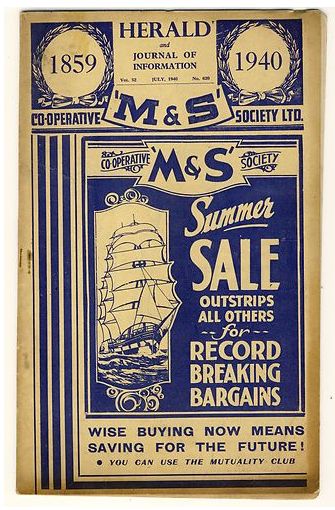
The source of much information about the Manchester & Salford Equitable Co-operative was the monthly publication, given away free in the stores. These are three covers from 1940 and as you'd expect have the patriotic tone of wartime. You could spend a small fortune bidding for co-operative memorabilia on that e-bay.

The nearest I've come to a complete collection 1889 - 1960 in slim bound volumes is at the National Co-operative Archives in Manchester. But even they are missing a few.

Other Societies issued similar monthly magazines, and those that didn't often gave away a CWS publication called Wheatsheaf that had local news section.

Wednesday, April 4, 2012

Beech Road Co-op

Old Step M&S Co-op
There used to be a M&SE Co-op store on Beech Road, Chorlton. Try as I might I have never found a photograph of it. Even Andrew Simpson with his weblog of Chorlton history hasn't discovered one yet, and he has a knack of acquiring long forgotten postcards and old photographs.

The shop opened around 1915 or 1916. It is in the Street Directory for 1916. A butchers opened some years later around the corner. By 1967 they were gone. So in that 50 years it must have been captured on camera.

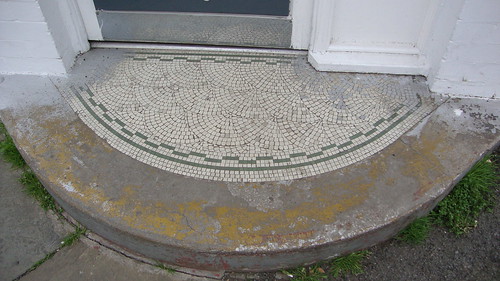
All we have to remind us is the mosaic step at the entrance to 64 Beech Road. The familiar green and white of the Society.

64 Beech Road Chorlton

The upstairs was used as Co-op Meeting room for social functions, Womens Guild, talks and such like. Very likely the entrance was on Stockton Road. Previous to its co-op days it was also a grocery store with the proprietor Nathianal Burrows.

Sunday, April 1, 2012

Coffees of Empire

The fourth in a series entitled "Foods of the Empire". The victuals people would buy at their local Co-Op when the maps of the world had large areas shaded in red.

You somehow feel that Britain has come to terms with its imperialist past. The recent BBC Tv five part series "Empire", an excellent travelogue / documentary with Jeremy Paxman suggests that.

Here is coffee essence a peculiar British product. A thick gooey syrup that was suppose to taste like coffee after hot water was poured over it. It is still retailed in places but I can't bear to purchase any. I remember it first time around. Ingredients : 40% water, 30% sugar, 26% chicory essence, 4% coffee essence, stabilisers and thickeners.

The label says everything about Empire and that later creation the Commonwealth. Manufactured by Patterson & Sons in Glasgow from 1875. The iconic label of an military officer in the Gordon Highlanders and a Sikh gentleman being a waiter / batman serving up the delicious sweet drink. That was the black and white days. Now the firm is a brand of the McCormick & Company (think of those over-priced Schwartz herbs and spices) it has been re-designed with both chaps sitting together enjoying the beverage. There was an intermediate design of the chap in his turban standing with the tray airbrushed out. Redolent of those Stalinist era photographs, when the old Bolsheviks got removed from the picture after Uncle Joe had them executed.

Getting back to the beverage I've always wondered why Britain, in the days of Empire, never got to grips with coffee making at home? Also the use of chicory in this product is an interesting and separate story. It can make an acceptable drink when there is a coffee shortage but there wasn't one.

Saturday, March 31, 2012

Road or it that Lane Re-opened

Hardy Lane at night
At last the roadworks are gone, the road re-opens again. But when the construction team comes to lay down the tram track then severe distruption will be for months. The picture is at night and has a quality like an oil painting, yes it is blurred. That's the bookies at the corner of Hardy Lane and Barlow Moor Road. Need to take more photographs for this junction will change forever.

Friday, March 30, 2012

Butter of Empire

CWS empire butter
The advertisement is from Friday 17th April 1931 in the Manchester Guardian. Another in the series of Foods of The Empire. It says it is the first direct consignment, presumably from New Zealand to the Manchester Ship Canal. The S.S. Surrey was a steamship of the New Zealand Shipping Company. Built in 1919, with a tonnage 8,580 and like many of their ships was named after an English county. The ship was sunk in 1942 in the Second World War.

The New Zealand Produce Association had offices in Tooley Street, London and was set up by the CWS and the Marketing Association of New Zealand in 1922 after a visit by a CWS delegation to New Zealand. It served importers of agricultural produce which the CWS required for its factories. An international co-operative undertaking by both producers and consumers.

Links : New Zealand Shipping Company History
You can email : coop AT biffadigital.org with any information that will help in the making of this history.