Thursday, March 15, 2012

Civic Pride

The Manchester Co-operative Societies - colour advert from Manchester Guardian, 1926
Manchester Civic Week was 2nd - 9th October 1926. It featured a pageant through to Albert Square, concerts and you could visit factories in Trafford Park to see how products were produced. A full programme of pride and propaganda. The "Manchester Guardian" had a supplement and this is a colour advert from it.

This advert shows four co-operative societies that traded within the boundaries of the city - Manchester & Salford Equitable Co-operative Society, the Failsworth Industrial Society, Beswick Co-operative Society and the Blackley Co-operative Society. Just over the city limits would be the Prestwich, Eccles Provident, Pendleton, two Oldham societies, Bury, two Rochdale societies and etc.

Co-op Societies were fiercely independent, accountable to their local membership. The downside was they overlapped, and the Beswick opened stores in M&SE territory. Eventually the local strength proved to be a weakness when the multiples got their act together in the 1950's and had stores across the regions of England and with mergers and takeovers became national players.

There is all the symbolism of the sun's rays, a banner being hoisted by strong men above the Manchester coat of arms. The observant will notice that the ship only has two sails, currently it has three and in earlier 19th Century styles it came in full rigging of about 15 sales.

The quote is by George Jacob Holyoake and is a shortened version from which appears in his "The history of co-operation in England: its literature and its advocates" published in 1875.

There is some great silent newsreel footage shot of the parade into Albert Square, Manchester. Stealing the show is the visit by Sir Alan Cobham who was a celebrated air pioneer. Silent footage and copyright restricted but you can view it here.

Photo credits : Mickey Ashworth Flickr Photos

George Jacob Holyoake's book is in the Internet Archive. The quote is on page 5

Wednesday, March 14, 2012

Minerals as in pop

Jewsbury & Brown
The advert is for J and B Mineral Waters by the veritable Manchester institution of Jewsbury and Brown who had their main factory and laboratories at Ardwick Green. It was a short walk around the corner to the M and S Equitable Co-Op's head office and central stores on Downing Street, Manchester. The Victorian building remains reduced to the three storeys from the glory of five storeys.

They sold aerated waters, colloquially we call it "pop", soda water, ginger beer and cordials throughout Lancashire. It merged into Schweppes in 1964. Their old bottles and other memorabilia are sought after by collectors of such ephemera.

Sunday, March 11, 2012

Teas of Empire

Picking Empire Grown Tea
Co-operative Tea
If you subscribe to enough email updates of other bloggers then occasionally something will surprise you.

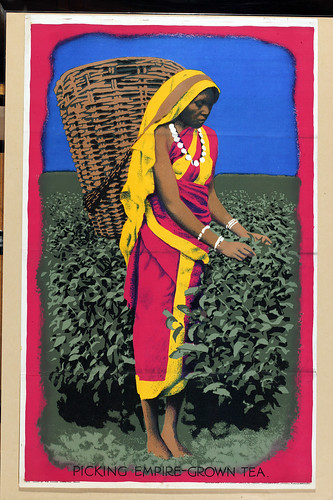
An interesting one is Curatorial Space which is behind the scenes at Manchester City Art Gallery. This led to looking at their online collection of Empire Marketing Board posters. That's one on the left by H.S. Williamson from the 1930's.

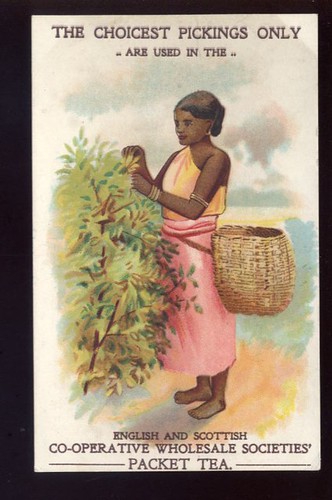
As a way of contrast there is a E&SCWS postcard below, from around the same time. The artwork is not as sharp and crisp as the one by the E.M.B.  Both shew tea picking by women wearing no shoes and a few bangles, and I'm guessing in Ceylon.

Produce from the Empire wasn't just foreign imports it was highlighted as a selling point of quality and very British to eat. For example Australian tinned fruit, Canadian flour, New Zealand lamb, and bananas from the West Indies.

It is all a bit suspect to modern sensibilities, but for a historian you tell the story of the propaganda of that age without endorsing the values.

The Empire Marketing Board commissioned these posters from 1926-1933 to promote trade and understanding between empire countries, but they are in essence propaganda that sends out a message of industry, nourishment and civilisation as seen from the powers in London. This view persisted until the trading patterns changed with Britain's entry to the Common Market (later called the EEU, now the EU) in 1973.

The English & Scottish CWS appear to have joined in with a series of picture postcards depicting work on the Co-operative's own tea estates.

If you wish to see the E.M.B. posters, and there are at least 200 of them then browse over to the Flickr collection. The quality of the paintings is superb. As a side note there are a four posters about imports and exports with the Irish Free State.

Saturday, March 10, 2012

Frozen Food 1950's

Frozen Food 1950 at the Co-op
Having a few items in the freezer is taken for granted. But back in the 1950's it was a novelty for Britain. Most people then didn't have a refrigerator with its small compartment for frozen food. Just keeping butter and milk cool in summer was down to having a decent larder or a piece of furniture in the kitchen called a meat safe.

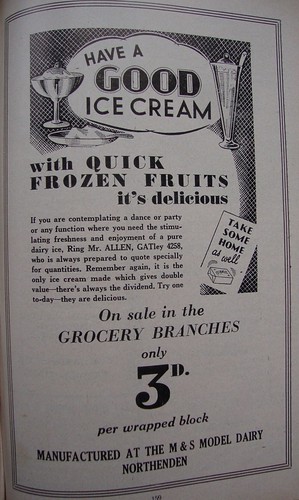
The picture is from 1950 and shews the Co-op employee at the Great Western Street branch talking up the merits of frozen food to the busy housewife. Note the chest freezer with whatever is inside buried in the dark. The selling point then and now has always been economy & convenience - there is no waste, and you don't have to wash and peel the vegetables - the birth of the ready meal. The M and S Co-op could announce "no less than 44 of our grocery branches now have a refrigerator which carries a stock of fruit, vegetables, or frozen fish fillets. Why not give yourself a treat and try the new flavour of quick-frozen foods?"
ice cream 1950
We all have to thank Clarence Birdseye with lots of help from his wife Eleanor for this. Their experiments in the kitchen to bring the winter of Labrador to the summer of New England by mechanical means gave the world quick-frozen food. That was back in the early 1920's. It took years and millions of dollars of development before it arrived into small grocery stores. Now you take it for granted. However you have to have a whole separate logistics of warehousing, transporting, and retail cabinets to move food at minus 21 degrees celsius from the factory to the home.

Home refridgerators with their tiny icebox were still an expensive purchase for those on workers wages. So the ice cream would have to eaten within an hour or so of purchase.

I would recommend reading the development of Birds Eye in the UK from 1946 to become market leader if you want to know more about the frozen food industry.
www.blackwellpublishing.com/grant/docs/13BirdsEye.pdf

Wednesday, March 7, 2012

Quiet Setting

The photograph is dated August 1975 and shews a tree lined Hardy Lane being the wide cul-de-sac that it is. You have to thank Mr. A. Dawson who took his camera around Manchester in the 1970's taking snaps of ordinary buildings and streets. Even when you do this today you catch some strange looks off passers-by, and maybe he got some odd looks too.

At present we can't go and recreate this scene because of the roadworks blocking Hardy Lane, see the previous post.

Photo : m17868 Courtesy of Manchester Libraries, Information and Archives, Manchester City Council. Link

Tuesday, March 6, 2012

Road Closure

Traffic Chaos Hardy Lane
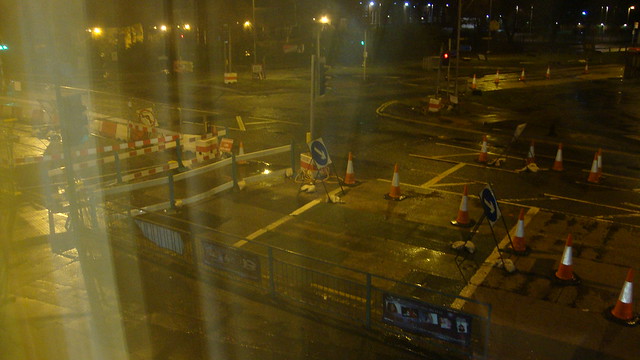
A photograph taken from the upstairs in the Co-Op Rooms at Hardy Lane. The road is closed, Barlow Moor Road is reduced to single lane traffic, and the trees have been felled on Mauldeth Road West.

Monday, March 5, 2012

National Loaf or Hovis


Yet another post about the National Loaf. If you read the history you'd believe it was the only bread available during WW2. So I asked someone who lived through the war years as a young girl. What was the bread like in the war? They could only recall eating Hovis. Now memory is deceptive. But it is true Hovis was available and was advertised in the newspapers.

Hovis was sold at co-operative stores, and other shops, for it had an interesting business model. Your local bakery bought the patented flour from Hovis, along with the baking tins indented with the Hovis name. Thus the bread was clearly marked as a Hovis loaf a popular and respected brand.

What is different about Hovis flour is the addition of partially cooked wheatgerm and salt. The display advertisements mention Macclesfield, which was the home of Hovis which commenced in 1886. Nearer to home there is a large mill and grain elevator in Trafford Park which manufactured Hovis flour from 1914. If you visit the Imperial Museum North you can't miss seeing the mill with its large concrete silos. It was severly damaged in the Blitz of 1940 but subsequently repaired.

Now just when you think you know all about a subject, even a tiny subject of the National Wheatmeal Bread then along comes another fact that changes your understanding of the history.

Related links : The National Loaf

Sunday, March 4, 2012

New Bridge on the Mersey

The map shews a new bridge to carry the new tram route to Manchester Airport. It takes a straight route from the end of the Hardy Lane as a roadway across the meadow land to the River Mersey. The old footbridge to Jackson's Boat can be seen north of the new tram route. This will be all be completed by 2016. It's been a long time since the plans were first proposed. So long ago it has become a distant memory of when I did work in Wythenshawe and they were announced. But work has started, it is no longer a description on paper and those are real foundations in the photograph.
New Bridge over River Mersey

The Open Street Map people have gone forward in time and have put the new route onto the existing road layout. Bridge building, even just footbridges, used to be such a massive engineering achievement but if you think how many have been opened in recent years over the River Mersey, the River Irwell in Manchester and the River Thames in London it is fairly commonplace.

Open Street Map Reference
You can email : coop AT biffadigital.org with any information that will help in the making of this history.